On this page
How to identify it
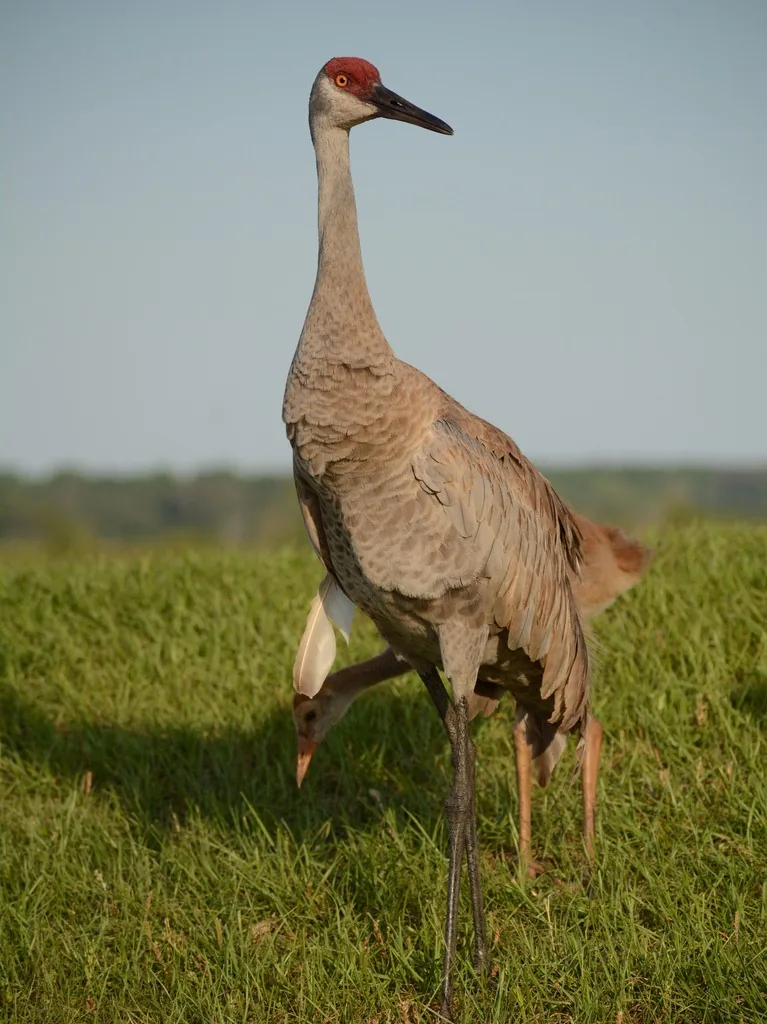
- A very large gray bird, almost 4 feet tall with a wingspan around 6.5 feet, with a long neck and long legs. UF/IFAS says the Florida sandhill crane weighs approximately ten pounds; males and females look alike, though males are typically slightly taller and heavier.[1][2][3]
- Adults have a patch of bald red skin on top of the head; FWC says to look for it for a positive identification. UF/IFAS adds a white cheek patch, a long straight black beak and yellow to reddish eyes, and says the gray plumage can look rusty-brown from iron staining when cranes preen with muddy water.[2][4][3]
- Cranes fly with the neck stretched straight out, unlike herons, which tuck the neck in.[2]
- Their loud bugling or rattling calls are often heard in natural areas or overhead. UF/IFAS says the call, described as trumpeting, rattling, bugling or croaking, can be heard up to 2 miles away.[1][4]
- The drooping, bushy feathers over the tail are actually elongated wing feathers, UF/IFAS says. Juveniles are slightly smaller with a rusty-brown crown that turns red as they mature, and the downy young, called colts, are yellowish-brown and lack the red crown.[3]
Look-alikes
| Look-alike | How to tell them apart |
|---|---|
| Great blue heron | Herons fly with the neck tucked and hunt fish, while cranes fly with the neck outstretched and don't fish. UF/IFAS says sandhill cranes are slightly larger than great blue herons and do not fish by stabbing prey the way herons do.[2][4][3] |
Where it lives
About 4,000 to 5,000 nonmigratory Florida sandhill cranes live in peninsular Florida north to southern Georgia, joined each winter by about 25,000 migratory greater sandhill cranes that nest in the Great Lakes region. Across the country, GBIF has about 2.1 million U.S. records since 1990, the most from Florida, Wisconsin and Michigan, and about 254,000 from Canada. UF/IFAS says the Florida subspecies ranges from Georgia's Okefenokee Swamp to the Everglades, with the largest populations in the Kissimmee and Desoto Prairie regions. Migrant greater sandhill cranes arrive in October and November and leave from January to March, and the two subspecies are often visually indistinguishable.[2][5][6][4]
Biology and life cycle
Pairs are monogamous and court with dances of jumping, running and wing-flapping. UF/IFAS adds bowing, unison calling and tossing sticks or grass, says pair bonding begins at 2 years of age, and gives 5 years as the average age of first successful breeding.[2][4][3]
They nest in late winter and spring on mats of vegetation in shallow water. Females usually lay two eggs, which hatch after about 32 days. UF/IFAS gives the primary nesting season as February to April, in water averaging 5 to 13 inches deep, and says pairs may re-nest up to 3 times in a year if a nest fails.[2][4]
Within 24 hours of hatching the young can follow their parents away from the nest, and they can leave their parents at about 10 months old. UF/IFAS says young stay flightless for up to 70 days, fledge at 65 to 70 days and are fully independent at around 248 to 321 days. Many chicks die before fledging, mostly to predators such as raccoons, bobcats, bald eagles, river otters, hawks, owls, feral hogs, coyotes and alligators.[2][4]
Cranes eat seeds, grain, berries, insects, earthworms, snakes, frogs, crayfish and small rodents and birds. UF/IFAS says they scratch with their feet or probe with their bills to reach food underground.[2][4]
In neighborhoods they are drawn to mowed grass and foods such as acorns, earthworms, mole crickets and turf grubs.[1]
Cranes can live 20 years or more.[2]
UF/IFAS says parents fiercely defend their young against predators such as alligators, coyotes and cats by kicking, and will even defend against humans.[3]
UF/IFAS gives year-round home ranges for paired adults averaging 1100 acres, with exclusive nesting territories of 300 to 635 acres, and average dispersal from the birth site of 2.5 miles for males and 7.2 miles for females.[4]
Damage and signs
- Cranes damage window screens and scratch at windows, glass doors and shiny cars, probably defending territory against their own reflection.[1]
- They sometimes dig up lawns and gardens while hunting mole crickets and beetle grubs.[1]
- Cranes that are fed can lose their fear of people, approach closely, grab food from hands and, rarely, peck people.[1]
- On farms, a review of crane studies worldwide found sandhill crane numbers have risen sharply over the past 40 years along with more feeding on crops, mostly corn and wheat, though actual crop damage turned up in only about 10 percent of the crane-farm interactions studied.[7]
- UF/IFAS says cranes in residential areas may be drawn to bird feeders and eat seed meant for smaller birds, and habituated cranes may peck at windows, vehicles or other reflective surfaces, causing scratches.[3]
Health risk
Habituated cranes may approach people closely and, in rare cases, peck them.[1]
Control
Prevention
Never feed cranes, and ask neighbors not to; cranes are less likely to stay in neighborhoods without easy meals.[1]
Stop accidental feeding, such as bird seed spilled from feeders onto the ground.[1]
UF/IFAS advises hanging bird feeders high so cranes can't forage from them directly.[4]
Keep about 100 yards from nesting cranes; UF/IFAS says disturbance by people can lead to nest abandonment and failure. Keep cats and dogs inside or on a leash, and slow down for cranes crossing roads, especially in breeding season.[4]
Keep them out
Cover or move cars so cranes can't see their reflections, and temporarily cover windows or glass doors they attack.[1]
A string fence on stakes about 2.5 feet off the ground keeps cranes away from window or pool screens they are damaging.[1]
Biological control
Accept some lawn digging: cranes feeding on mole crickets and grubs provide natural control of these turf pests.[1]
Legal status
The Florida sandhill crane is protected by the federal Migratory Bird Treaty Act and is a State-designated Threatened species.[2]
Since 2002, intentionally feeding sandhill cranes has been illegal under Florida Administrative Code 68A-4.001(6).[1]
The federal Migratory Bird Treaty Act prohibits killing, capturing, selling or transporting protected migratory birds without authorization from the U.S. Fish and Wildlife Service.[8]
USFWS says no federal depredation permit is needed just to scare or harass migratory birds, except eagles and federally listed species. A permit to capture or kill birds causing damage requires proof that nonlethal steps such as scare devices or habitat changes were tried first, plus a review form from USDA Wildlife Services. In Florida the crane is also state-designated Threatened, so check with FWC before going beyond covering windows and cars.[9][2]
Why feeding hurts cranes
Fed cranes cross roads to reach yards, and many are killed by vehicles each year in Florida.[1]
Cranes in neighborhoods face more power line collisions, garbage entanglement and attacks on young by dogs and cats.[1]
A steady diet of one food, such as corn, disrupts their naturally varied diet, and young cranes have died from lawn pesticide poisoning.[1]
Threats to Florida cranes
UF/IFAS names loss of habitat as the main threat: wetland drainage, conversion of native rangeland to farms or development, and fire suppression that lets woody plants invade marshes.[4]
UF/IFAS says that between 1974 and 2003 potential crane habitat in Florida declined by 17% and the population by an estimated 36%, though more recent studies suggest the population is increasing, possibly because cranes are using suburban areas.[4]
Cranes feeding on harvested peanut fields can be partially paralyzed and may die from mycotoxins in rotting peanuts, UF/IFAS says.[4]
UF/IFAS says a fluke that infects the trachea is among the most common parasites of sandhill cranes, affecting more than 40% of them.[3]
Where the sources disagree
Eggs and lifespan: FWC says females lay two eggs that incubate for 32 days and that some cranes reach 20 years old; UF/IFAS gives 1 to 3 eggs (average 2), incubation of 29 to 32 days, and an average lifespan of 7 years, though some live more than 20.[2][4]
Common questions
- Why is a sandhill crane pecking my window or car?
- It is probably reacting to its reflection as a rival. Cover the glass or move the car so it can't see itself.[1]
- Is it illegal to feed sandhill cranes in Florida?
- Yes. Intentionally feeding them has been illegal since 2002 under Florida Administrative Code 68A-4.001(6).[1]
- Are sandhill cranes and great blue herons the same bird?
- No. Cranes have bald red skin on the crown and fly with outstretched necks; herons fly with necks tucked and, unlike cranes, fish.[2]
- How long do young sandhill cranes stay with their parents?
- UF/IFAS says colts can leave the nest with their parents within 24 hours of hatching, fledge at 65 to 70 days and stay with their parents for up to 10 months.[4][3]
Sources
- Florida Fish and Wildlife Conservation Commission, “Living with Sandhill Cranes.” myfwc.com/conservation/you-conserve/wildlife/sandhill-cranes/ (accessed 2026-11-11)
- Florida Fish and Wildlife Conservation Commission, “Sandhill Crane species profile.” myfwc.com/wildlifehabitats/profiles/birds/cranes/sandhill-crane/ (accessed 2026-11-14)
- UF/IFAS Extension Sumter County, “Wildlife & Invasive Species Education (WISE) Species Profile: Florida Sandhill Crane (J. Davis, September 13, 2024).” blogs.ifas.ufl.edu/sumterco/2024/09/13/wildlife-invasive-species-education-wise-species-profile-florida-sandhill-crane/ (accessed 2026-11-14)
- University of Florida IFAS Extension (EDIS, via journals.flvc.org), “Wildlife of Florida Factsheets: Florida Sandhill Crane, WEC448/UW493 (H. Fox, B. Wight, H. Ellington, May 2022).” journals.flvc.org/edis/article/view/129400 (accessed 2026-11-14)
- Global Biodiversity Information Facility (GBIF), “Antigone canadensis: U.S. occurrence records since 1990 by state (GBIF occurrence search).” api.gbif.org/v1/occurrence/search?taxonKey=2474953&country=US&hasGeospatialIssue=false&occurrenceStatus=PRESENT&year=1990%2C2026&facet=stateProvince&facetLimit=400&limit=0 (accessed 2026-11-11). Exact count at access: 2,074,244 U.S. records since 1990 (Florida 381,285; Wisconsin 372,476; Michigan 295,875).
- Global Biodiversity Information Facility (GBIF), “Antigone canadensis: occurrence records since 1990 by country (GBIF occurrence search).” api.gbif.org/v1/occurrence/search?taxonKey=2474953&hasGeospatialIssue=false&occurrenceStatus=PRESENT&year=1990%2C2026&facet=country&limit=0 (accessed 2026-11-11). Exact counts at access: 2,334,550 records since 1990; United States 2,074,244, Canada 253,957, Mexico 1,364.
- Ecology and Evolution, via PubMed, “Winners and losers of land use change: A systematic review of interactions between the world's crane species (Gruidae) and the agricultural sector (Hemminger et al. 2022).” pubmed.ncbi.nlm.nih.gov/35356570/ (accessed 2026-11-11)
- U.S. Fish and Wildlife Service, “Migratory Bird Treaty Act of 1918.” www.fws.gov/law/migratory-bird-treaty-act-1918 (accessed 2026-11-11)
- U.S. Fish and Wildlife Service, “3-200-13: Migratory Bird - Depredation (permit).” www.fws.gov/service/3-200-13-migratory-bird-depredation (accessed 2026-11-11)
- iNaturalist, “Antigone canadensis taxon page (order and family).” www.inaturalist.org/taxa/508048 (accessed 2026-10-06)