On this page
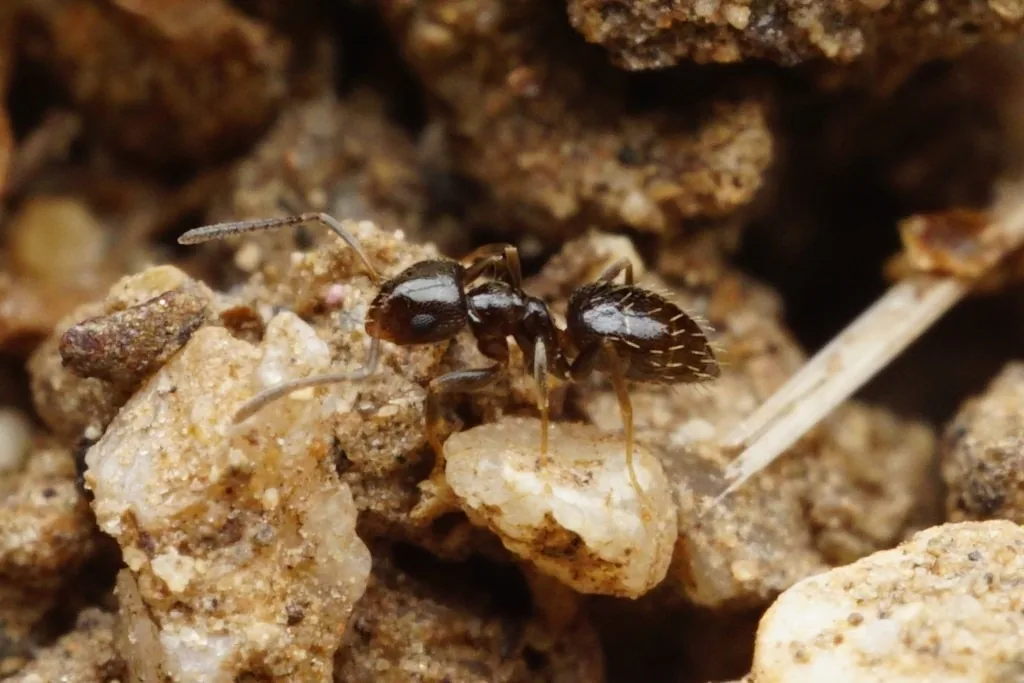
How to identify it
- Workers are minute, about 1.5 mm (1/16 inch), all one size, and medium to blackish brown, with pale feet and mandibles and brownish-yellow antennae. UF/IFAS gives workers as 1 to 2 mm, queens 3 mm and males 1 mm.[1][3][4]
- Like all rover ants, they have 9-segmented antennae with no club and a one-segmented waist.[1][3]
- The single waist node is hidden under the abdomen, the front of the thorax is humped, and there is no stinger.[3][1]
- Compared with other rover ants, the dark rover ant has relatively large eyes, four to six stout erect hairs on top of the thorax, and sparse but fairly long fine hairs on the abdomen. UF/IFAS lists the same three features: long hairs on the thorax, relatively large eyes and sparse flat-lying hairs on top of the abdomen.[1][4]
- Workers forage without making trails, though UF/IFAS notes that in the laboratory trails form between parts of a colony.[4]
Look-alikes
| Look-alike | How to tell them apart |
|---|---|
| Thief ant | Thief ants are yellow to light brown, with a two-node waist and 10-segmented antennae ending in a 2-segmented club; rover ants have 9 segments and no club.[5][3] |
| Pharaoh ant | Pharaoh ants are yellow to orange, with two waist nodes and 12-segmented antennae ending in a 3-segmented club, and they travel in set trails.[6] |
Where it lives
It was first reported in the United States in 1978, though specimens collected in Mobile, Alabama show it has been present since at least the 1950s. The Mississippi Entomological Museum lists it from Alabama, Arkansas, Arizona, California, Florida, Georgia, Louisiana, Mississippi, North Carolina, New Mexico, Nevada, South Carolina, Tennessee and Texas, and GBIF records come mostly from Texas, Mississippi and California. The museum also cautions that the genus needs revision and some U.S. specimens may prove to be a different species. UF/IFAS says it was first seen in Louisiana in 1976 and misidentified at the time as Brachymyrmex musculus. It is more common in northern than southern Florida, where it may compete with the closely related, very abundant Brachymyrmex obscurior, and it is established in Houston, Dallas and San Antonio. In southern California, where it was first reported in 2010, workers have been found foraging on pavement next to turf.[1][7][4]
Biology and life cycle
Genetic studies of invasive U.S. populations found that most colonies occupy a single nest with a single queen, nests spaced as close as every 2.5 m (about 8 feet). Unlike most invasive ants, colonies fight their neighbors instead of forming supercolonies, although an earlier museum account described neighboring colonies as tolerant of each other. UF/IFAS reports strong aggression between colonies in the laboratory, says multiple-queen colonies have not been seen in the wild, and notes colonies tend to set up satellite colonies.[8][9][3][1][4]
Colonies range from hundreds to a few thousand workers. They nest in soil, rotting wood and mulch, and also in potted plants and wall voids. UF/IFAS adds tree bases, leaf litter, wood piles and rubbish heaps, says it occurs in natural and disturbed areas but seems more common around people, and notes it is commonly found in landscape mulch.[3][1][4]
Their diet is thought to be largely honeydew from soil-dwelling aphids and mealybugs, and they are drawn to sweet baits and liquids. UF/IFAS says it also visits extrafloral nectaries: on Opuntia stricta cactus in Wakulla County, Florida, it was more common than three native ants and favored the parts of the plant with the most nectaries.[1][3][4]
Winged males and queens fly to mate on summer evenings and are attracted to lights; the Mississippi Entomological Museum has collected them from late April through early August. UF/IFAS says winged ants have been seen from May to August in the southeastern states, and mating flights may happen year round in Tucson, Arizona.[3][1][4]
Laboratory work shows it needs relatively high moisture. UF/IFAS says that in the arid Southwest it is likely limited to places with enough water, such as irrigated landscapes.[4]
It lives close to many other ants, including the red imported fire ant and the southern fire ant, which usually don't tolerate other ants nearby.[4]
Damage and signs
- There are no reports of structural damage. It is a nuisance pest because workers and winged ants enter houses, hospitals, schools and other buildings to forage or nest, sometimes in very high numbers in urban areas.[1][3]
- Texas A&M notes that indoor infestations are often tied to moisture or wood decay. UF/IFAS cites anecdotal reports that it tends to invade bathrooms and kitchens. In the desert, foragers may come indoors and nests may form inside during the hot, dry spring and summer, and large numbers of winged ants in swimming pools are a frequent problem.[3][4]
- UF/IFAS says that in Mississippi, university staff reported in 2005 and 2006 that questions about dark rover ants outnumbered those about all other ant species.[4]
Health risk
Dark rover ants don't bite or sting (they have no stinger), and there are no reports of them transmitting disease. UF/IFAS also says it does not bite, sting or transmit disease.[1][3][4]
Control
Prevention
Fix moisture problems and replace water-damaged wood. UF/IFAS adds that changing irrigation and other landscape practices may help control colonies outdoors, and that controlling excess moisture indoors and in mulch near the building may lower the chance of an invasion.[3][4]
Because winged ants are attracted to lights, UF/IFAS suggests the bulb type or the placement of light fixtures may affect whether they set up nests in a building.[4]
Keep them out
Find and seal entry points on the outside of the building.[3]
Sanitation
Remove or treat nesting areas under landscape timbers and rocks around the home.[3]
Pesticides
Sources disagree on baits. Texas A&M says rover ants seem unattracted to many liquid and granular baits and suggests contact insecticide at entry points, gel baits or dusts in electrical outlets and aerosols in voids. Two studies found otherwise for one bait type: an imidacloprid bait killed over 95% of lab colony fragments in 15 days, and around homes it cut foragers by 83% and left only about a quarter of the original colonies, with colonies foraging within 1.5 m (about 5 feet) of a bait station the most likely to be eliminated. Always follow the label.[3][2][10]
In lab tests of barrier sprays on surfaces, lambda-cyhalothrin and indoxacarb still killed rover ants 90 days after application, while fipronil performed no better than untreated controls; treatments on porous surfaces worked less well.[2]
When to call a professional
Pest management professionals have reported difficulty controlling it, in one case after as many as 15 applications, and Texas A&M calls it one of the more difficult ants to control. Because colonies are small and close together, bait placement matters. UF/IFAS notes that because it spread so fast, it is a relatively new problem for many pest professionals and extension staff.[1][3][10][4]
Where the sources disagree
First U.S. record: UF/IFAS says it was first observed in Louisiana in 1976, while the Mississippi Entomological Museum gives the first report as 1978 and says specimens from Mobile, Alabama show it was present since at least the 1950s.[1][4]
Flight season: the Mississippi Entomological Museum has collected winged ants from late April through early August, while UF/IFAS gives May to August in the southeastern states and possibly year round in Tucson.[1][4]
Nests: UF/IFAS says colonies tend to set up satellite colonies, while genetic studies of U.S. populations found most colonies occupy a single nest.[4][8][9]
Common questions
- Why won't my ant bait kill rover ants?
- Many granular and liquid baits don't attract them. Research found imidacloprid baits can work, but only when stations sit close to the many small colonies, since each colony forages only a short distance.[3][2][10]
- Do rover ants bite or sting?
- No. They have no stinger and there are no reports of bites, stings or disease; they are a nuisance pest.[1][3]
- Why are tiny winged ants swarming my porch light?
- Dark rover ant swarmers fly on summer evenings and are attracted to lights. UF/IFAS says large numbers of winged ants ending up in swimming pools is another frequent problem.[3][1][4]
- Where did dark rover ants come from?
- They are native to Argentina and Paraguay. UF/IFAS says they were first seen in the U.S. in Louisiana in 1976 and have spread rapidly through the Gulf States.[4]
Sources
- Mississippi Entomological Museum, Mississippi State University, “Brachymyrmex patagonicus Mayr 1868, 'Dark Rover Ant' (J. A. MacGown; last updated April 7, 2016).” mississippientomologicalmuseum.org.msstate.edu/Researchtaxapages/Formicidaepages/genericpages/Brachymyrmex.patagonicus.htm (accessed 2026-11-11)
- Insects, via PubMed, “Miguelena JG, Baker PB (2014), Evaluation of liquid and bait insecticides against the dark rover ant (Brachymyrmex patagonicus), Insects 5(4):832-848.” pubmed.ncbi.nlm.nih.gov/26462943/ (accessed 2026-11-11). Cited from the PubMed abstract.
- Texas A&M Center for Urban and Structural Entomology, “Rover Ant.” urbanentomology.tamu.edu/urban-pests/ants/rover/ (accessed 2026-11-11)
- University of Florida IFAS Extension (EDIS), “Dark Rover Ant, Brachymyrmex patagonicus Mayr, EENY498/IN899 (Featured Creatures).” ask.ifas.ufl.edu/publication/IN899 (accessed 2026-11-14)
- University of California Statewide IPM Program, “Key to Identifying Common Household Ants: Thief Ant.” ipm.ucanr.edu/TOOLS/ANTKEY/thief.html (accessed 2026-11-11)
- University of California Statewide IPM Program, “Key to Identifying Common Household Ants: Pharaoh Ant.” ipm.ucanr.edu/TOOLS/ANTKEY/pharaoh.html (accessed 2026-11-11)
- Global Biodiversity Information Facility (GBIF), “Brachymyrmex patagonicus: occurrence records in the U.S., 1990-2026 (GBIF occurrence search).” api.gbif.org/v1/occurrence/search?taxonKey=1317320&country=US&hasGeospatialIssue=false&occurrenceStatus=PRESENT&year=1990%2C2026&facet=stateProvince&facetLimit=400&limit=0 (accessed 2026-11-11). State counts are records reported (iNaturalist research-grade, museum specimens, surveys), not abundance.
- Ecology and Evolution, via PubMed, “Eyer PA, Espinoza EM, Blumenfeld AJ, Vargo EL (2020), The underdog invader: breeding system and colony genetic structure of the dark rover ant (Brachymyrmex patagonicus Mayr), Ecology and Evolution 10(1):493-505.” pubmed.ncbi.nlm.nih.gov/31993123/ (accessed 2026-11-11). Cited from the PubMed abstract.
- Ecology and Evolution, via PubMed, “Eyer PA et al. (2021), Divide and conquer: multicolonial structure, nestmate recognition, and antagonistic behaviors in dense populations of the invasive ant Brachymyrmex patagonicus, Ecology and Evolution 11(9):4874-4886.” pubmed.ncbi.nlm.nih.gov/33976855/ (accessed 2026-11-11). Cited from the PubMed abstract.
- Pest Management Science, via PubMed, “Shults P, Eyer PA, Moran M, Chura M, Ko A, Vargo EL (2022), Assessing colony elimination in multicolonial ants: estimating field efficacy of insecticidal baits against the invasive dark rover ant (Brachymyrmex patagonicus), Pest Management Science 78(6):2250-2257.” pubmed.ncbi.nlm.nih.gov/35212165/ (accessed 2026-11-11). Cited from the PubMed abstract.
- iNaturalist, “Brachymyrmex patagonicus taxon page (order and family).” www.inaturalist.org/taxa/356419 (accessed 2026-11-11)