On this page
How to identify it
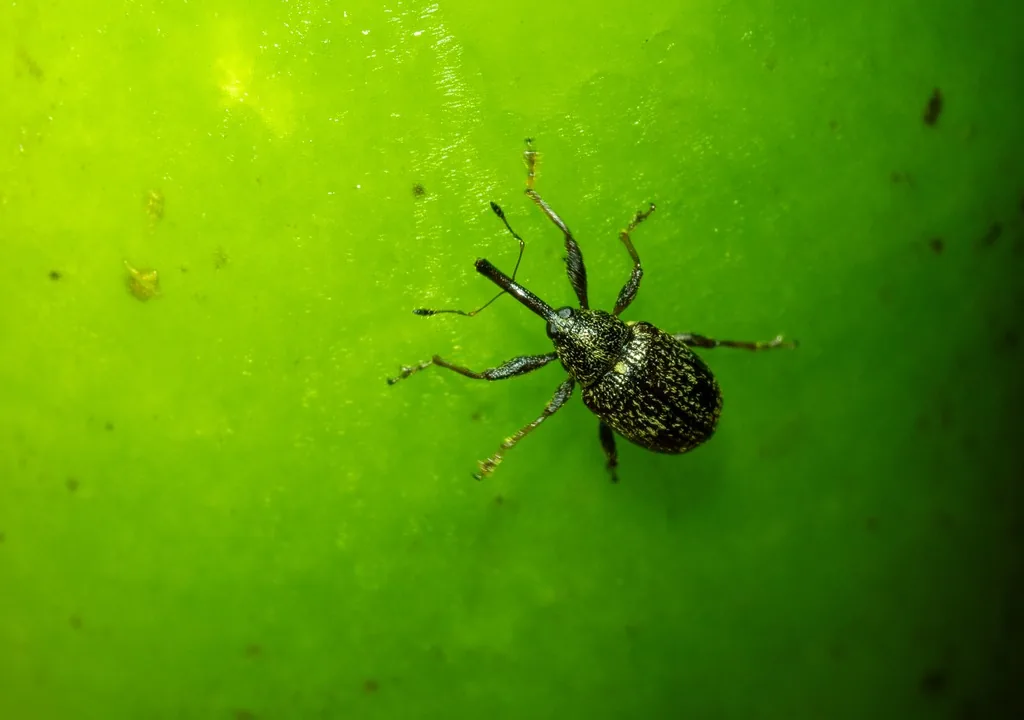
- Adults are small, about 1/8 inch (2 to 3.5 mm) long, with an arched oval body and a long snout. EPPO describes them as dark brown to grayish black and covered with small white or yellowish scales; UC IPM notes a brassy sheen on the dark body.[1][2]
- Larvae are legless, C-shaped, off-white grubs with a brown head, about 1/4 inch (5 to 6 mm) long when full grown.[2][1]
- Early signs are small holes in young fruit and small round or oval holes (2 to 5 mm) in leaves, which can be mistaken for slug or caterpillar damage.[1]
- Other weevils of the same size share its host plants and range, so a confident ID needs an adult beetle; eggs, larvae and pupae can't be identified by sight.[1]
Where it lives
EPPO says it comes from Mexico and spread through Central America, the Caribbean, Hawaii, French Polynesia and the southern United States in the early 1900s; a 2025 modeling study instead calls it native to Central America. EPPO lists U.S. records from Arizona, California, Florida, Georgia, Hawaii, Louisiana, New Jersey, New Mexico, North Carolina, South Carolina, Texas and Virginia, plus Ontario in Canada. In southern California it is a common pest that moves in from warm-winter areas or survives year-round after mild winters.[1][3][2]
Biology and life cycle
Females chew a cavity in a bud or the base of a young pod, lay one egg in it and seal it. Larvae feed on the seed core or pod wall and pupate inside the fruit.[1][2]
Development speeds up with heat: EPPO cites a two-week life cycle at 27°C (81°F), three weeks at 21°C (70°F) and six weeks at 15°C (59°F), so there are several generations a year.[1][2]
Eggs are laid only in peppers and nightshade-family relatives. In a 2021 study, larvae developed in eastern black nightshade and climbing nightshade about 4 days faster than in jalapeño peppers, so these weeds can serve as breeding sites.[1][2][4]
UC IPM names silverleaf nightshade as a common alternate food plant. Adults also feed on other plants, including tomato and potato; EPPO notes no egg laying has been seen on potato.[2][1]
Damage and signs
- The main loss is buds and young fruit that turn yellow and drop. Larger fruit often stay on the plant even when infested, so the damage can end up in the harvest.[1][2]
- Larval feeding deforms and discolors the fruit, browns the core and makes it ripen and drop early. Egg and feeding wounds also let in a fungus (Alternaria alternata) that causes internal fruit rot.[1]
Health risk
It feeds on peppers and related plants, and no cited source describes any risk to people or pets.[1][2]
Control
Prevention
Check transplants for weevils before planting. If it was a problem, plant something other than peppers next season, and not tomato or eggplant, since both are in the same plant family.[2]
Sanitation
Pick up dropped and culled fruit during the season, and right after harvest remove and destroy remaining fruit and shred the old plants. Pull nightshade weeds in and around the garden or field.[2][1]
Traps and physical control
Yellow sticky traps, baited with the weevil's pheromone where available, show when adults arrive. UC IPM places them before bloom with the trap bottom just at or slightly below the plant tops.[2][1]
Pesticides
EPPO notes that insecticides only target adults, because eggs and larvae are inside the buds and fruit, so timing matters. UC IPM says to apply treatments when the first adult is captured on pheromone-baited yellow sticky traps, or when one or more adults are found per 400 buds checked, and lists pyrethrin as acceptable for organically grown peppers.[1][2]
Overwintering and egg laying
EPPO's datasheet notes that in Florida adults are found in every month except December and January, spending the winter on wild nightshades or old pepper plants. Overwintering adults can live about 10 months but only 2 to 3 months in summer, and a female lays roughly 340 to 600 eggs in her lifetime, about 5 to 7 a day.[1]
Which peppers it prefers
A 2021 laboratory study saw eggs laid in every fruit type offered, but far fewer weevils emerged from habanero fruit, which the authors linked to its high capsaicin content.[4]
EPPO notes that cultivar differences come mainly from how fast the fruit matures, and that greenhouse outbreaks in Canada, the Netherlands and a field outbreak in Italy were all eradicated.[1]
Where the sources disagree
Origin: EPPO says the pepper weevil originates from Mexico, while a 2025 modeling study calls it native to Central America.[1][3]
Larval size and development: UC IPM says mature larvae are about 1/4 inch (6 mm) and larval development takes 2 to 3 weeks; EPPO gives about 5 mm for the last larval stage and a larval stage of 9.5 days in the laboratory, or 6-12 days in Florida.[2][1]
Parasitic wasps: UC IPM says parasitic wasps have been seen on the larvae but their impact appears minimal, while EPPO says the most abundant larval or egg parasitoids found in Mexico and Canada are seen as potential candidates for biological control.[2][1]
Common questions
- Why are my pepper buds and fruit falling off?
- Pepper weevil larvae feeding inside buds and young pods are a common cause: infested buds and small fruit yellow and drop. Cut a dropped fruit open and look for a grub or a brown core.[1][2]
- Do some pepper varieties resist it?
- Somewhat. In a 2021 laboratory study eggs were laid in every fruit type offered, but far fewer weevils emerged from habanero fruit, which the authors linked to its high capsaicin content. EPPO says cultivar differences in susceptibility come mainly from the timing of fruit maturation.[4][1]
- Can I stop pepper weevils without spraying?
- Sanitation does most of the work: destroy dropped fruit and old plants after harvest, remove nightshade weeds and rotate away from peppers, tomatoes and eggplant.[2]
Sources
- European and Mediterranean Plant Protection Organization (EPPO Global Database), “Anthonomus eugenii (ANTHEU) datasheet.” gd.eppo.int/taxon/ANTHEU/datasheet (accessed 2026-11-13)
- University of California Statewide IPM Program, “Pepper Weevil (Peppers: Pest Management Guidelines).” ipm.ucanr.edu/agriculture/peppers/pepper-weevil/ (accessed 2026-11-13)
- Insects, via PubMed, “Modeling the Historical and Future Potential Global Distribution of the Pepper Weevil Anthonomus eugenii Using the Ensemble Approach (Xiao et al. 2025).” pubmed.ncbi.nlm.nih.gov/40870604/ (accessed 2026-11-13)
- Pest Management Science, via PubMed, “Host utilization by the pepper weevil (Anthonomus eugenii): suitability, preference and offspring performance (Fernández et al. 2021).” pubmed.ncbi.nlm.nih.gov/34138509/ (accessed 2026-11-13)
- Global Biodiversity Information Facility (GBIF), “Anthonomus eugenii Cano, 1894 (GBIF Backbone Taxonomy).” api.gbif.org/v1/species/5013699 (accessed 2026-11-13)