On this page
How to identify it
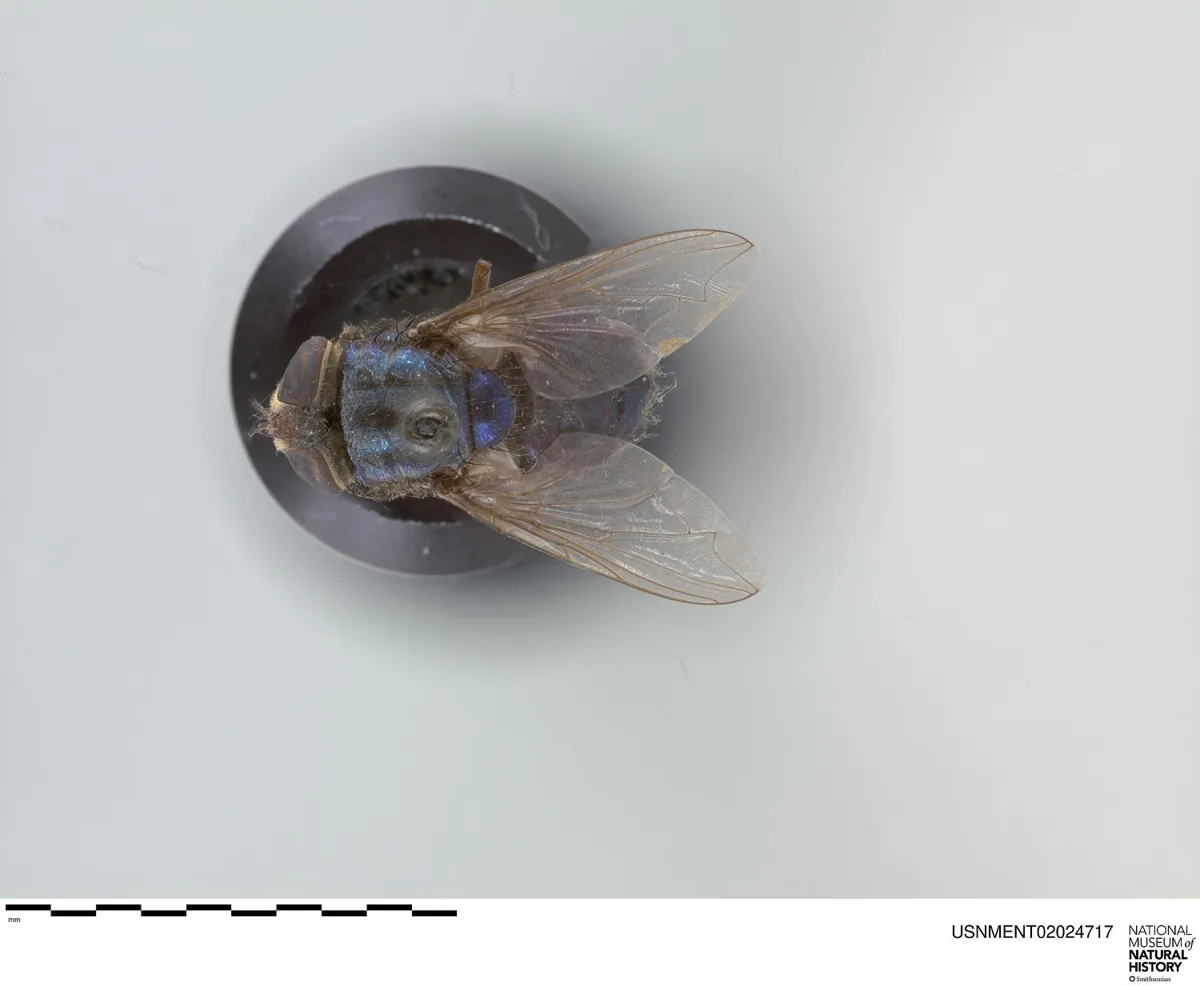
- Adults are metallic flies with three distinct stripes running back from behind the head, the middle stripe shorter.[1]
- Larvae are about 17 mm long, with rings of spines that look almost screw-like; a trained professional must confirm the species.[1]
- Infested wounds hold visible maggots, often smell foul and drain or enlarge.[1][2]
Look-alikes
| Look-alike | How to tell them apart |
|---|---|
| Secondary screwworm | Cochliomyia macellaria looks similar, but its back stripes are more even; it and other metallic blow flies lay eggs only on dead tissue.[1] |
Where it lives
Eradicated from the US by the mid-1960s with sterile flies, it re-emerged in Central America and southern Mexico, reached Nuevo León by September 2025, and USDA confirmed cases in La Salle and Andrews counties, Texas, on June 8, 2026; by November 2026 cases had also been confirmed in New Mexico and, from October 28, in Cochise County, Arizona.[1][2][4][5]
Biology and life cycle
Mated females are drawn to wounds as small as a tick bite or a barbed-wire scrape and can travel 6 to 12 miles to find one.[1]
Females lay 100 to 300 eggs that hatch in 6 to 8 hours, and the larvae feed for 5 to 7 days in living tissue before pupating in soil.[1]
Adult males live 3 to 4 weeks and feed on nectar; females live about 1 to 3 weeks.[1]
Damage and signs
Health risk
Infestations in people are rare; USDA advises anyone who notices a suspicious lesion to seek immediate medical care.[2]
Control
Prevention
Check animals often for draining or enlarging wounds, maggots or egg masses, signs of discomfort, and lesions in the nose, ears, genitals or navel.[2]
Treat wounds promptly; if an infestation occurs, cleaning out the maggots and topical larvicides such as permethrin are control options, guided by a veterinarian.[1]
When to call a professional
Report suspected cases right away to your veterinarian, state animal health official or USDA; in Texas, report livestock cases to the Texas Animal Health Commission.[2]
USDA fights outbreaks with 20 km quarantine zones and releases of sterile flies, which are dyed so trap catches can be told apart from wild flies.[2]
Status as of November 2026
As of November 9, 2026, USDA had confirmed 126 animal cases since June, up from 79 on November 1; 63 were active and 63 inactive. Of the 126, 124 were domestic animals such as livestock and pets, and two were elk in Pecos and Jeff Davis counties, Texas. Wild screwworm flies had also turned up in six surveillance traps, four of them in October and one in November; trap finds are not counted as animal cases.[4]
On October 28, 2026, USDA confirmed the first Arizona case, a dog in Cochise County, and set up a 20-km infested zone with animal movement controls, extra surveillance and trapping, and sterile fly releases.[5]
The Texas Animal Health Commission lists infested-zone movement restrictions in parts of 25 Texas counties: Bandera, Brewster, Crockett, Culberson, Edwards, El Paso, Fisher, Hudspeth, Irion, Jeff Davis, Jim Hogg, Medina, Mitchell, Nolan, Pecos, Presidio, Reagan, Reeves, Schleicher, Scurry, Starr, Sutton, Terrell, Val Verde and Zapata (orders through November 10, 2026). Warm-blooded animals in an infested zone may not move out of it without prior TAHC authorization.[6]
CDC reports no human infestations acquired in the United States in this outbreak and rates the risk to people as very low; one travel-related case was confirmed in August 2025 in a person who returned from El Salvador (CDC, updated October 29, 2026).[7]
Counts change from day to day. USDA's public dashboard lists every confirmed detection by county, state, animal and status; this section was checked against it, TAHC and CDC on November 12, 2026.[8]
Common questions
- Is the New World screwworm in the United States?
- Yes. USDA confirmed cases in La Salle and Andrews counties, Texas, in June 2026, including a dog that early reports said had recently been in Mexico. By November 9, 2026, USDA counted 126 animal cases in Texas, New Mexico and Arizona.[2][4]
- Can screwworm get into meat or produce?
- No. USDA says it doesn't infest meat, fruits, vegetables or other food products.[2]
- What should I do if I see maggots in an animal's wound?
- Contact your veterinarian, state animal health official or USDA immediately.[2]
Sources
- Penn State Extension, “Understanding the New World Screwworm: Biology, Identification, and Prevention (updated October 24, 2025).” extension.psu.edu/understanding-the-new-world-screwworm-biology-identification-and-prevention (accessed 2026-10-06)
- USDA Animal and Plant Health Inspection Service, “USDA Confirms Two Additional Cases of New World Screwworm in the United States (June 8, 2026).” www.aphis.usda.gov/print/pdf/node/8171 (accessed 2026-10-06)
- iNaturalist, “Cochliomyia hominivorax taxon page (order and family).” www.inaturalist.org/taxa/354351 (accessed 2026-10-06)
- Texas Public Radio (USDA data), “New World screwworm cases surge nearly 60% in eight days, with new detection in Bandera County (last updated Nov. 9, 2026).” www.tpr.org/public-health/2026-07-03/31-confirmed-new-world-screwworm-infestations-texas-tracker-and-what-you-need-to-know (accessed 2026-11-12)
- USDA APHIS, “USDA Confirms New World Screwworm in Arizona (October 28, 2026).” www.aphis.usda.gov/news/agency-announcements/usda-confirms-new-world-screwworm-arizona (accessed 2026-11-12)
- Texas Animal Health Commission, “New World Screwworms: infested-zone movement restrictions and Executive Director Orders (orders through November 10, 2026).” www.tahc.texas.gov/emergency/nws.html (accessed 2026-11-12)
- Centers for Disease Control and Prevention, “New World Screwworm Outbreak: situation summary (updated October 29, 2026).” www.cdc.gov/new-world-screwworm/situation-summary/index.html (accessed 2026-11-12)
- USDA APHIS, “Confirmed Detections of New World Screwworm (public dashboard).” www.aphis.usda.gov/animals/animal-health/livestock-and-poultry-disease/stop-screwworm/current-status/confirmed (accessed 2026-11-12)