On this page
How to identify it
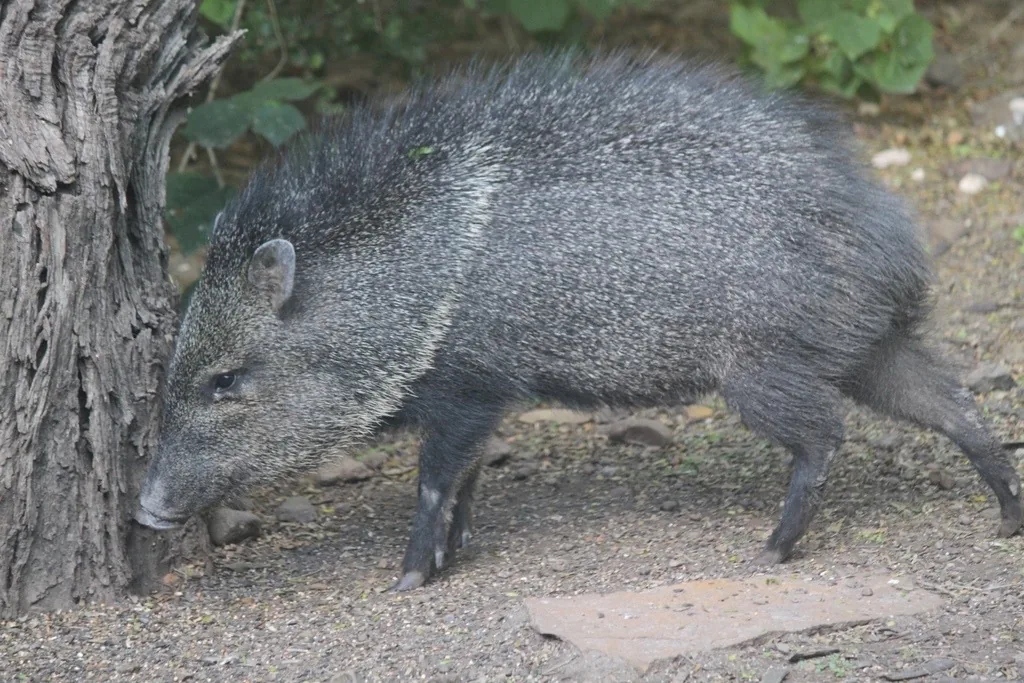
- Built low to the ground, adults stand about 18 inches tall and are 32 to 36 inches long. Saguaro National Park puts the average adult at 40 to 60 pounds, while Texas A&M AgriLife says mature javelina average 48 to 50 pounds.[1][3]
- Coarse, salt-and-pepper hair with a ring of white and gray hair around the neck that looks like a collar; a mane of darker hair on the neck and shoulders bristles when the animal faces danger.[1][3]
- Unlike pigs, it has small, rounded ears, no visible tail and only one dewclaw on each hind leg.[4][3]
- Young javelina are called reds because of their reddish color.[3]
- A scent gland on the rump gives off a musky odor. Herd members rub against each other's glands to recognize one another, and they mark territory by rubbing the gland on rocks, shrubs and trees.[3][1]
- They have sharp canine teeth about two inches long and grind the upper and lower canines together, making a chattering noise that warns predators and other javelina.[1][3]
Look-alikes
Where it lives
Found in Texas, New Mexico, Arizona and through much of Latin America; in Texas they live in the South Texas Plains, Trans-Pecos, Edwards Plateau and Rolling Plains. Saguaro National Park says javelina came from Central America and moved north into the southwestern United States about 250 years ago.[3][1]
Biology and life cycle
Javelina belong to the peccary family, Tayassuidae, along with the Chacoan and white-lipped peccaries. They resemble pigs but are not in the pig family.[3][1]
They live in herds, which Saguaro National Park says average 12 animals and Texas A&M puts at 8 to 12. Texas A&M gives home ranges of about 200 to 900 acres; in Arizona, the park says each herd needs about 750 acres.[1][3]
Their sense of smell is excellent, their hearing average and their eyesight poor; their noses help them find underground roots and nearby predators.[1]
They are most active in the cooler parts of the day, which in summer means early morning and early evening, and they shelter from the midday sun under large trees, in caves and under rocky overhangs.[1]
They are omnivores but eat mostly plants: prickly pear pads and fruit, other cactus, agave hearts, mesquite beans, jojoba nuts, roots, forbs and flowers, plus some insects.[1][3]
Javelina can breed year-round, starting at about 11 months when conditions are good. Gestation is about 145 days, roughly five months; females can have two litters a year, usually twins, and the young can follow the herd after their first day. Texas A&M gives a life expectancy of about 10 years in the wild.[3][1]
Damage and signs
Health risk
Javelina have a natural fear of people and usually run away, but one that feels cornered or is protecting its young can act aggressively toward people or their pets. Hand-feeding can make them lose that fear and seek out people and their food.[1]
Control
Prevention
Plant bulbs javelina dislike, such as iris and narcissus, instead of favorites like tulips.[2]
Keep pets on a leash whenever they are out of the yard, since a cornered javelina can act aggressively toward pets.[2][1]
Keep them out
Fencing may be needed to keep javelina out of a garden; poultry wire laid at or just below the soil surface helps protect beds from digging. Securely close openings to spaces under buildings and mobile homes.[2]
Sanitation
Never feed javelina. Store garbage securely, feed pets indoors or remove leftover pet food, and keep birdseed from spilling onto the ground.[2][1]
Traps and physical control
Scare them away with a vinegar spray, a garden hose, small rocks or loud noises.[2]
If javelina are in your yard
Javelina will run away from people when given the chance, so give them space; a cornered javelina, or one protecting young, can act aggressively.[1]
If you find a baby javelina that seems abandoned, leave it. The mother was most likely frightened away and will return once you have gone.[1]
Ask neighbors to remove food and water sources too, since herds move between nearby lots.[2]
Legal status
In Texas, javelina are a native big game species. For 2026-27, 99 of 254 counties have javelina seasons; the Northern Zone runs October 1, 2026, to February 28, 2027, the Southern Zone September 1, 2026, to August 31, 2027, and the bag limit is two per license year.[5][3]
Arizona law lists the peccary (javelina) as big game, and it is unlawful to take wildlife except as the state's game laws permit, during a closed season, or with an unlawful device or method.[6][7]
Arizona's unlawful feeding law makes feeding or attracting wildlife, other than birds and tree squirrels, a petty offense in counties of more than 280,000 people; University of Arizona Extension names Pima and Maricopa counties.[8][2]
Common questions
- Are javelina wild pigs?
- No. They are peccaries, a separate family of hoofed mammals; they are smaller than feral hogs, with round ears, no visible tail and a pale collar.[3][4][1]
- Are javelina dangerous to my dog?
- They can be. A javelina that feels cornered or is protecting its young can act aggressively toward pets, so keep dogs on a leash and give herds space.[1][2]
- Why do javelina keep coming back to my yard?
- They are after food. Flowerbeds, bulbs, birdseed, garbage and pet food can keep a herd coming back, and animals drawn to one home often visit the neighbors too.[1][2]
Sources
- National Park Service, Saguaro National Park, “Javelina.” www.nps.gov/sagu/learn/nature/javelina.htm (accessed 2026-11-12)
- University of Arizona Cooperative Extension, “Potential Wildlife Conflicts, AZ1481c (October 2009).” extension.arizona.edu/sites/extension.arizona.edu/files/pubs/az1481c.pdf (accessed 2026-11-12)
- Texas A&M AgriLife Extension, “Collared Peccary (Pecari tajacu), RWFM-PU-420 (September 2024).” agrilifeextension.tamu.edu/wp-content/uploads/2025/07/Javelinas-2024.pdf (accessed 2026-11-12)
- Texas A&M AgriLife Extension, Feral Hogs in Texas, “Feral Hogs vs. Javelina.” feralhogs.tamu.edu/feral-hogs-vs-javelina/ (accessed 2026-11-12)
- Texas Parks and Wildlife Department, “Javelina: 2026-2027 Seasons & Regulations.” tpwd.texas.gov/regulations/outdoor-annual/regs/animals/javelina/ (accessed 2026-11-12)
- Arizona State Legislature, “A.R.S. 17-101, Definitions.” www.azleg.gov/ars/17/00101.htm (accessed 2026-11-12)
- Arizona State Legislature, “A.R.S. 17-309, Violations; classification.” www.azleg.gov/ars/17/00309.htm (accessed 2026-11-12)
- Arizona State Legislature, “A.R.S. 13-2927, Unlawful feeding of wildlife; classification.” www.azleg.gov/ars/13/02927.htm (accessed 2026-11-12)
- iNaturalist, “Pecari tajacu taxon page (order and family).” www.inaturalist.org/taxa/42113 (accessed 2026-11-12)