On this page
How to identify it
- Full-grown caterpillars are smooth, plump and 1-1/2 to 2 inches long, light to deep pink (pinkish-white, says Wisconsin) with a brown head; Iowa State says they look like cutworms.[1][2][3]
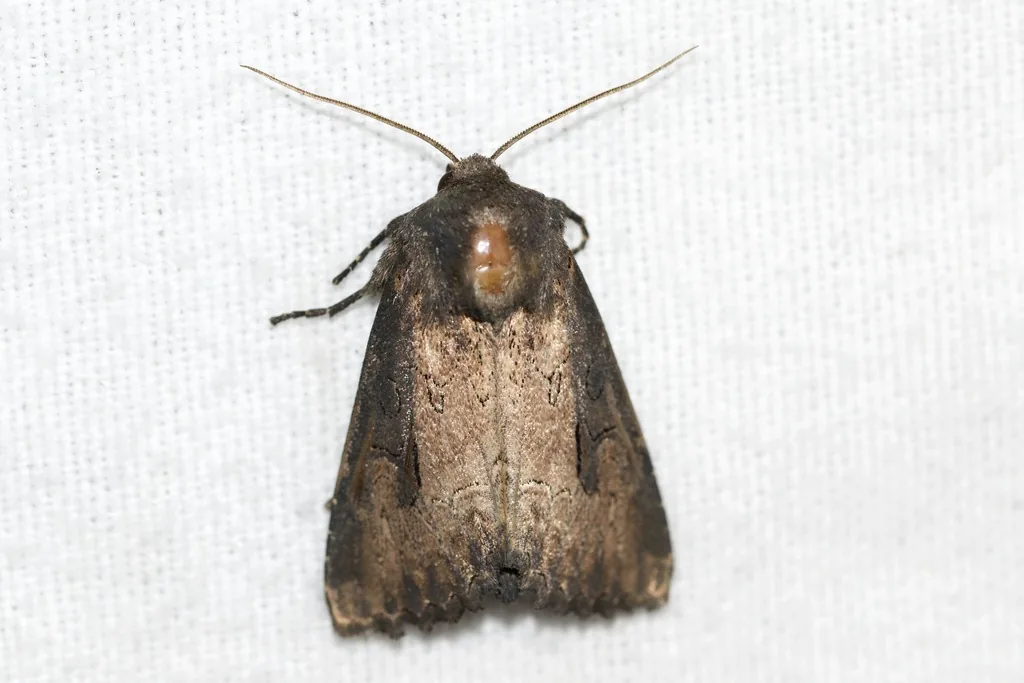
- Moths have chocolate-brown front wings and lighter yellow-brown hind wings spanning up to 2 inches, and they fly at night.[1]
- Early signs are pinprick holes and tan or water-soaked streaks in the leaves; Iowa State says damage first shows in May or June as dark-streaked, watery areas or ragged leaf edges.[1][2]
- Pupae are shiny and dark chestnut brown, in the soil near damaged rhizomes.[2]
Look-alikes
| Look-alike | How to tell them apart |
|---|---|
| Iris leaf diseases | Bacterial soft rot, iris scorch and fungal leaf spot also brown leaf tips, so check for caterpillars and tunnels before blaming borers.[1] |
Where it lives
Extension services in Minnesota, Wisconsin and Iowa all describe it as the most serious or destructive insect pest of iris; in Minnesota the caterpillars reach the rhizome by July.[1][3][2]
Biology and life cycle
Eggs overwinter on old iris leaves and debris at the base of the plants. They hatch in early spring: April or early May in Iowa, early May in Wisconsin.[1][2][3]
Tiny caterpillars climb the new leaves, tunnel down and reach the rhizome by midsummer.[1]
In late July or early August they pupate in the soil, and moths emerge in late summer or fall to lay eggs on old iris plants and debris in August and September. There is one generation a year.[1][3][2]
Damage and signs
- Feeding streaks can let in bacterial soft rot, which leaves rhizomes slimy, soft and foul smelling; Wisconsin says the smell comes from other bacteria that move into the rotting tissue. Rhizomes can be hollowed out completely.[1][3][2]
- Sources differ on how often plants die. Minnesota says leaf tips brown and plants weaken but whole plants die very rarely; Wisconsin says attacked plants discolor, wilt and die in late June and July.[1][3]
Health risk
It feeds on iris. The Minnesota, Wisconsin and Iowa State pages treat it only as a plant pest and don't mention any risk to people or pets.[1][3][2]
Control
Prevention
All iris can be attacked, but bearded iris suffer most; Siberian iris tolerate borers better, and Wisconsin says dwarf iris also have few problems.[1][3]
Sanitation
Remove and destroy old iris leaves, stems and nearby debris to kill the overwintering eggs: Minnesota says any time after a hard frost, Iowa State says fall or early spring. Wisconsin notes cleanup helps but won't always end the problem.[1][2][3]
When dividing iris, discard borers and damaged rhizomes; Iowa State says treating the soil before replanting has no benefit.[2]
Traps and physical control
In spring, crush small caterpillars inside the leaves (Wisconsin says they are about 1/4 inch long as they start tunneling) or remove damaged leaves. In July, dig plants with dying leaves and discard infested rhizomes, plus any pupae in the nearby soil.[1][3][2]
Biological control
Steinernema or Heterorhabditis nematodes, applied to moist soil as leaves near full size, can reduce borer numbers. Wisconsin reports success with June and early July soil drenches, while Iowa State says their effectiveness hasn't been documented in Iowa.[1][3][2]
Pesticides
Where iris borer has been a problem, a spray timed to egg hatch can help, and it only works on small larvae before they tunnel deep into the plant. Minnesota and Wisconsin time it to leaves or shoots about 4 to 6 inches long, Iowa State to 5 to 6 inches. Minnesota names acephate or spinosad (its page was last reviewed in 2018); Wisconsin and Iowa State list azadirachtin, pyrethrins, permethrin or spinosad. All three say to follow the label directions.[1][3][2]
Moths you'll rarely see
The moths fly at night and are seldom seen, so damage on the leaves is usually the first clue.[1]
A 1989 USDA study found that female iris borers release several of the same pheromone compounds as the tobacco budworm, and a three-part blend of them caught males in field traps.[4]
Where the sources disagree
Caterpillar color: Minnesota says pinkish; Iowa State says light to deep pink; Wisconsin says pinkish-white.[1][2][3]
Plant death: Minnesota says the entire plant dies very rarely; Wisconsin says attacked plants discolor, wilt and die during late June and July.[1][3]
Spray timing: Minnesota and Wisconsin say leaves or shoots 4 to 6 inches long; Iowa State says 5 to 6 inches.[1][3][2]
Products: Minnesota names acephate or spinosad; Wisconsin and Iowa State list azadirachtin, pyrethrins, permethrin or spinosad.[1][3][2]
Cleanup: Minnesota says any time after a hard frost; Iowa State says fall or early spring.[1][2]
Nematodes: Wisconsin says Heterorhabditis or Steinernema soil drenches in June and early July have been successful; Minnesota says they may not always work but generally reduce borer numbers; Iowa State says their effectiveness has not been documented in Iowa.[3][1][2]
Egg hatch: Iowa State says April or early May; Wisconsin says early May; Minnesota says early spring.[2][3][1]
Common questions
- Why are my iris leaf tips turning brown?
- Iris borers are one cause, but bacterial soft rot, scorch and leaf spot look similar. Look for caterpillars and tunnels in leaves or rhizomes.[1]
- When is the best time to clean up iris beds?
- Minnesota says any time after a hard frost, when moths have stopped laying eggs; Iowa State says fall or early spring, before the eggs hatch.[1][2]
- Do I need to spray every year?
- Minnesota says no: if your iris haven't been affected in the past, you do not need a pesticide to protect them; watch for early signs instead.[1]
Sources
- University of Minnesota Extension, “Iris borers (Yard and garden insects).” extension.umn.edu/yard-and-garden-insects/iris-borers (accessed 2026-11-13)
- Iowa State University Extension and Outreach, “Iris Borer (Yard and Garden, 2020).” yardandgarden.extension.iastate.edu/encyclopedia/iris-borer (accessed 2026-11-13)
- University of Wisconsin-Madison Extension, Wisconsin Horticulture, “Iris Borer.” hort.extension.wisc.edu/articles/iris-borer/ (accessed 2026-11-13)
- J Chem Ecol 1989;15(5):1559-66, via PubMed, “Female sex pheromone of iris borer, Macronoctua onusta (Lepidoptera: Noctuidae) (1989).” pubmed.ncbi.nlm.nih.gov/24272098/ (accessed 2026-11-13)
- Global Biodiversity Information Facility (GBIF), “Macronoctua onusta Grote, 1874 (GBIF Backbone Taxonomy).” api.gbif.org/v1/species/1768132 (accessed 2026-11-13)
- iNaturalist, “Macronoctua onusta taxon page (order and family).” www.inaturalist.org/taxa/224312 (accessed 2026-10-06)