On this page
How to identify it
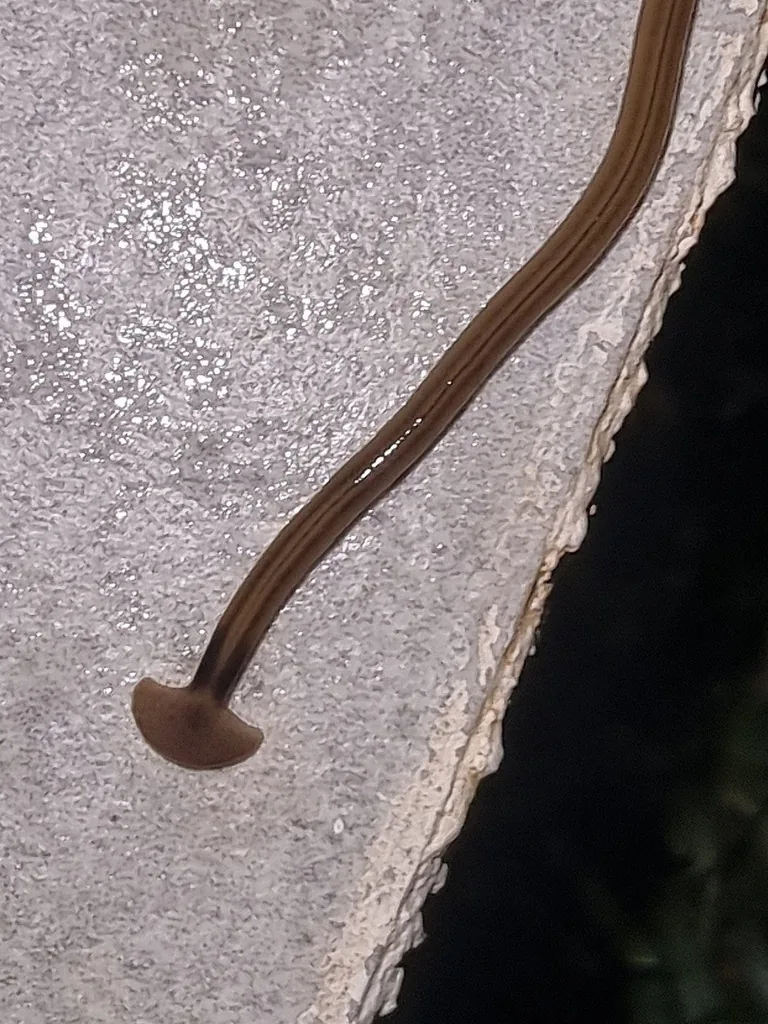
- A long, flat, slimy worm with a broad, shovel- or half-moon-shaped head, like a hammerhead shark or pickaxe.[4][3][2]
- One to several dark stripes run down the length of the body. The large shovel-headed garden worm (Bipalium kewense) is light tan to yellow-brown with five dark stripes and a dark, broken collar behind the head. UF/IFAS describes Florida's land planarians as greenish-gray to brown with narrow dark stripes on the back, and B. kewense as pale with a dark line down the middle, a dark patch at the neck and an expanded, crescent-shaped (lunate) head.[4][3][2][14]
- Bipalium kewense is one of the largest land flatworms, up to 10 inches (Texas A&M) or 12 inches (Penn State) long. Other North American species are smaller: B. adventitium reaches about 3.1 inches and B. vagum about an inch. UF/IFAS says B. kewense can reach 30 cm (11 7/8 in), and land planarians in general run 3 to 50 cm long and 0.2 to 0.5 cm wide.[1][2][14]
- They are covered in slime that helps them move and keeps them from drying out, and they can hang from leaves or branches on a string of mucus.[3][1]
- They have no anus: a single opening near the middle of the underside serves as both mouth and anus, and a muscular tube (the pharynx) pushes out of it to feed.[14]
Look-alikes
| Look-alike | How to tell them apart |
|---|---|
| Earthworms, including jumping worms | Hammerhead worms closely resemble earthworms but have one or more stripes down the body and a flattened, shovel-shaped head.[4] |
| Slugs | Some dark flatworms can be mistaken for slugs, but flatworms lack the tentacles of slugs and have no texture on the body.[3] |
| Dolichoplana striata | Another land planarian reported in Florida. UF/IFAS, quoting a classic description, gives it a very long, flattened body up to 120 mm, yellowish brown with six dark lengthwise stripes, of which the two black side stripes are the most conspicuous.[14] |
Where it lives
Native to Asia; USDA lists Southeast Asia for B. kewense, while Penn State gives Vietnam and Cambodia. It was introduced to the U.S. around 1891 in infested plants and soil, and Penn State calls it widespread in the eastern U.S., as far north as Pennsylvania and Illinois. GBIF has about 7,600 U.S. records of the genus since 1990, the most from California, Texas, North Carolina, Georgia and Florida, with others from Mexico, France and Japan. UF/IFAS gives its natural range as Vietnam to Kampuchea (Cambodia), possibly Malaysia. It says B. kewense was first described from a greenhouse at Kew near London in 1878 and has been common in American greenhouses since 1901. It has been found outdoors in Florida, Louisiana, California, Georgia, the Carolinas and Texas, and in greenhouses from Alabama to New York and Illinois; it is spreading north along the Atlantic Coast and can survive freezing in sheltered spots such as under boards. UF/IFAS also notes reports from Arizona's high desert in 2003, Massachusetts in 2004, New Hampshire in 2005 and northern California in 2006.[5][2][4][6][7][14]
Biology and life cycle
Hammerhead worms track prey by chemical scent, then wrap their bodies around it in sticky mucus and digest it. Illinois lists earthworms, slugs, isopods and insect larvae as prey, but Penn State says B. kewense eats only earthworms and B. vagum only snails and slugs.[1][4][3][2]
A wandering broadhead planarian (B. adventitium) will trail and attack earthworms 100 times its own mass, and the tetrodotoxin found in these worms probably helps them subdue large prey.[8]
They need moisture and hide under rocks, logs, leaf litter and mulch. NC State says they may be active at any time of year when temperatures allow.[4][3][2]
They can reproduce by breaking off a piece near the tail, which grows a new head; they also mate and lay egg cocoons. Most B. kewense in North America reproduce by splitting, and French specimens showed no genetic variation, which suggests they are clones.[4][3][2][9]
UF/IFAS says reproduction is mainly by fragmentation: the sides pinch in about 1 cm from the tail tip, the tail piece sticks to the ground as the parent pulls away, and a lightly pigmented head starts forming within 7 to 10 days. One or two pieces are released each month.[14]
Eggs are bright red, laid in cocoons that turn black within 24 hours, and the young emerge in about 21 days.[14]
They avoid light by day, move and feed at night and need high humidity: UF/IFAS says they survive drying only if they lose no more than 45 percent of their body weight. They are most abundant in spring and fall and turn up on the soil surface after heavy rains.[14]
They glide on a strip of closely spaced cilia (the creeping sole) over a thin coat of mucus. They find prey with chemical sensors under the head, hold it down in slimy secretions and push the pharynx into it. They can go many weeks without food by slowly shrinking, even using their own reproductive tissue.[14]
Land planarians also eat each other, and UF/IFAS says that cannibalism may make them their own worst enemy.[14]
Damage and signs
- They do not attack plants. Their impact is on earthworms, and they are a concern in earthworm farming.[1][3]
- Experts disagree on how much that matters. Texas A&M says little is known about their effect on earthworms; Penn State and NC State point out that most earthworms in yards and gardens are themselves introduced, and Penn State says planarians may even help against invasive jumping worms.[1][2][3]
- UF/IFAS says B. kewense and Dolichoplana striata have been reported as nuisances in earthworm rearing beds in the southern U.S., and two other flatworms accidentally imported to Ireland and England were reported capable of wiping out entire earthworm populations on farms. In greenhouses they are considered harmless to plants.[14]
Health risk
Two hammerhead species (B. adventitium and B. kewense) carry tetrodotoxin, the nerve toxin found in pufferfish, throughout the body and in egg capsules. A 2025 review estimates there is less than 200 ng per worm, so poisoning a person or other mammal would take swallowing hundreds of worms; touching one should not cause significant skin reactions, and the main advice after contact is to wash your hands.[8][10]
Control
Prevention
Inspect potted plants, nursery stock and mulch before bringing them home, and isolate plants that have worms. Heat-sterilize suspect potting soil before using or moving it.[4][3][1]
Penn State asks that flatworms found in pots of newly bought plants be preserved in alcohol and sent to your state department of agriculture, since several invasive species are not yet established in North America.[2]
To check for them, look by day under rocks and logs in cool, damp spots. Slime trails are a sign of land planarians but can also come from slugs or snails, and in worm beds look for planarians attached to earthworms by mucus.[14]
Traps and physical control
Don't cut them up, since each piece can grow into a new worm. Pick them up with tweezers and drop them into rubbing alcohol, or seal them in a bag and freeze them.[4][3][2]
Salt sprinkled on a single worm also kills it, but use it sparingly near plants because salt damages soil and plants.[4][3][2]
Pesticides
No pesticide treatment is recommended. Deal with worms one at a time, and don't spread salt or pesticides on the ground ahead of time, which harms plants and beneficial organisms.[1][11]
Where the sources disagree
Size of B. kewense: Texas A&M says up to 10 inches and Penn State up to 12 inches; UF/IFAS gives up to 30 cm (11 7/8 in).[1][2][14]
Diet: Penn State says B. kewense eats only earthworms; UF/IFAS, writing about land planarians in Florida (almost all of them Bipalium), lists earthworms, slugs, insect larvae and each other.[2][14]
Common questions
- Are hammerhead worms dangerous to touch?
- The risk is low. The worms carry a small amount of tetrodotoxin, but a 2025 review found that claims of danger to people from touching them lack scientific support. Wash your hands after contact.[10][8]
- What if my dog or cat eats a hammerhead worm?
- Researchers estimate a mammal would have to eat hundreds of worms to be poisoned. In a 1977 test, dogs fed several large B. kewense had no worms left in their intestines when examined 45 minutes to 12 hours later.[10][12]
- Why shouldn't I chop a hammerhead worm in half?
- They reproduce by breaking into pieces, and each fragment can grow a new head, so cutting them makes more worms.[4][3][2]
- Do hammerhead flatworms damage plants?
- No. UF/IFAS says that although some collectors believe they might damage plants, they are considered harmless in greenhouses; their impact is on earthworms.[14]
Sources
- Texas A&M AgriLife Extension, “Land planarians (ENT-1004).” citybugs.tamu.edu/factsheets/landscape/others/ent-1004/ (accessed 2026-11-11)
- Penn State Extension, “Hammerhead Flatworms and Other Land Planaria of Eastern North America.” extension.psu.edu/hammerhead-flatworms-and-other-land-planaria-of-eastern-north-america (accessed 2026-11-11)
- NC State Extension, “Terrestrial Flatworms, Land Planarians & Hammerhead Worms (Entomology Insect Notes).” content.ces.ncsu.edu/terrestrial-flatwormshammerhead-worms (accessed 2026-11-11)
- University of Illinois Extension, “Hammerhead Worm.” extension.illinois.edu/invasives/hammerhead-worm (accessed 2026-11-11)
- USDA National Invasive Species Information Center, “Hammerhead Worm (species profile).” www.invasivespeciesinfo.gov/terrestrial/invertebrates/hammerhead-worm (accessed 2026-11-11)
- Global Biodiversity Information Facility (GBIF), “Bipalium (genus): U.S. occurrence records since 1990 by state (GBIF occurrence search).” api.gbif.org/v1/occurrence/search?taxonKey=2502937&country=US&hasGeospatialIssue=false&occurrenceStatus=PRESENT&year=1990%2C2026&facet=stateProvince&facetLimit=400&limit=0 (accessed 2026-11-11). Exact count at access: 7,611 U.S. records since 1990 (California 1,033; Texas 981; North Carolina 746; Georgia 640; Florida 494; Pennsylvania 441).
- Global Biodiversity Information Facility (GBIF), “Bipalium (genus): occurrence records since 1990 by country (GBIF occurrence search).” api.gbif.org/v1/occurrence/search?taxonKey=2502937&hasGeospatialIssue=false&occurrenceStatus=PRESENT&year=1990%2C2026&facet=country&limit=0 (accessed 2026-11-11). Exact counts at access: 11,003 records since 1990; United States 7,611, Mexico 464, France 271, Japan 239.
- PLoS ONE, via PubMed Central, “Confirmation and distribution of tetrodotoxin for the first time in terrestrial invertebrates: two terrestrial flatworm species (Bipalium adventitium and Bipalium kewense) (Stokes et al. 2014).” pmc.ncbi.nlm.nih.gov/articles/PMC4070999/ (accessed 2026-11-11)
- PeerJ, via PubMed, “Giant worms chez moi! Hammerhead flatworms (Bipalium spp., Diversibipalium spp.) in metropolitan France and overseas French territories (Justine et al. 2018).” pubmed.ncbi.nlm.nih.gov/29844951/ (accessed 2026-11-11)
- Revista da Sociedade Brasileira de Medicina Tropical, via PubMed Central, “Crossing the health misinformation crisis: Lessons from the giant hammerhead flatworm (Pinto, Melo and Mati 2025).” pmc.ncbi.nlm.nih.gov/articles/PMC12534023/ (accessed 2026-11-11)
- Virginia Tech News (Insect Identification Lab, Department of Entomology), “Toxic hammerhead worms; expert provides advice for dealing with the invasive species at home (Aug. 15, 2023).” news.vt.edu/articles/2023/08/hammerhead_worms_expert.html (accessed 2026-11-11)
- Health Laboratory Science, via PubMed, “Evidence against gastrointestinal pseudoparasitism by the land planarian, Bipalium kewense (Daly, Matthews and Farris 1977).” pubmed.ncbi.nlm.nih.gov/833002/ (accessed 2026-11-11)
- iNaturalist, “Bipalium kewense taxon page (order and family).” www.inaturalist.org/taxa/64221 (accessed 2026-10-06)
- University of Florida IFAS Extension, EDIS (Featured Creatures), “Land Planarians, Bipalium kewense Moseley and Dolichoplana striata Moseley, EENY-049/IN206 (Featured Creatures).” ask.ifas.ufl.edu/publication/IN206 (accessed 2026-11-14)