On this page
How to identify it
- Penn State gives females as 5 to 14 mm long and males 5 to 12.5 mm; Utah State gives 1/5 to 6/10 inch and Washington State pictures a 3/8-inch adult.[1][2][3]
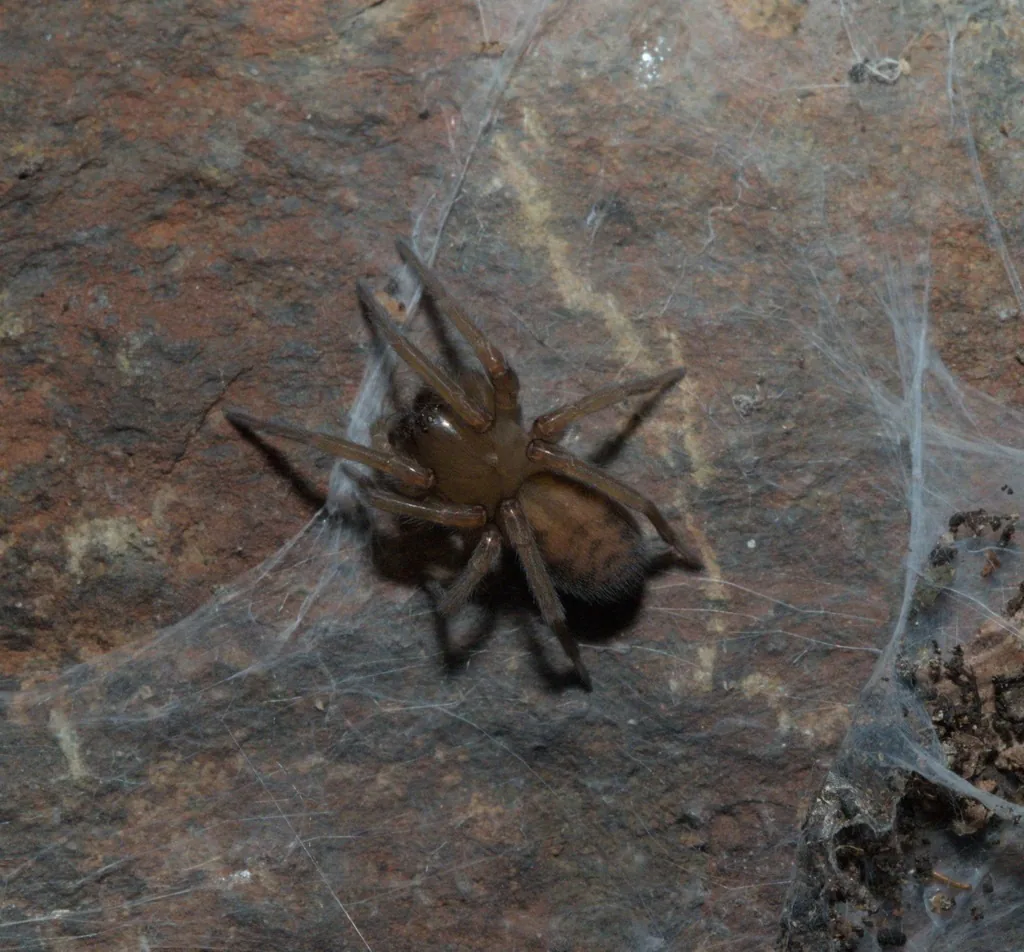
- The front body section is reddish mahogany brown, darkest around the eyes and jaws, and the legs are lighter.[1][2]
- The abdomen is usually gray, from pinkish to charcoal, with lighter spots and often chevron marks toward the rear.[1][2]
- It has 8 eyes in 2 rows, and the web is an irregular mesh with a poorly defined tube retreat.[2][1]
Where it lives
Extension services cover them from Pennsylvania to Utah and Washington, where Washington State says they are commonly found in crawl spaces in the western part of the state. Outdoors they live under bark, leaf litter and stones and in woodpiles.[1][2][3]
Biology and life cycle
Males overwinter as immature spiders, molt twice in spring, become adults in April and die after mating.[1]
Females turn up in every season and probably live at least two years.[1]
Egg sacs holding 73 to 175 eggs are laid where the spiders live, often in the web.[1][2]
They eat insects.[2]
Damage and signs
Health risk
Extension services say they rarely bite and are not considered medically significant. In a study of 33 verified spider bites in Oregon, which produced possibly the first records of Callobius bites, none caused significant symptoms, and a verified Amaurobius ferox bite in Switzerland caused only mild local symptoms with full recovery.[1][2][4][5]
Control
Prevention
Wear gloves to collect firewood and check it for spiders before bringing it in.[3]
Keep them out
Seal cracks along the foundation and outside walls, and fit tight door sweeps, thresholds and window screens.[2][3][6]
Sanitation
Cut back nesting spots around the house, clear clutter in basements and storage areas, and set boxes off the floor and away from walls, sealed with tape.[2][6]
Traps and physical control
Vacuum spiders and webs; the tumble through the hose usually kills them. Sticky traps catch wandering spiders that get inside.[6][2][3]
Pesticides
Pesticides are not generally needed. Retail sprays labeled for spiders contain pyrethrins or pyrethroids such as allethrin, but they only work when they hit the spider and give temporary control unless entry points are sealed; Washington State does not usually advise spraying these spiders outdoors.[6][3]
What the name means
Washington State calls them hackled band weavers. Males die soon after mating in spring, but females are found in every season and probably live at least two years.[3][1]
Common questions
- What are the brown spiders with gray abdomens in my damp basement?
- They may be hacklemesh weavers, which often turn up in damp basements in fall and winter.[1][2]
- Do hacklemesh weavers bite?
- Rarely. Verified bites by Callobius and Amaurobius in published studies caused only minor, local symptoms.[1][4][5]
- How do I get rid of them?
- Seal entry points, reduce clutter and damp hiding places, vacuum spiders and webs, and use sticky traps; sprays alone do not last.[2][6][3]
Sources
- Penn State Extension, “Hacklemesh Weaver Spiders.” extension.psu.edu/hacklemesh-weaver-spiders (accessed 2026-11-12)
- Utah State University Extension, “Hacklemesh Weaver Spiders (Nuisance Pests).” extension.usu.edu/planthealth/ipm/notes_nuisance/hacklemesh-weaver-spider (accessed 2026-11-12)
- Washington State University Extension, “Hackled band weavers (Pestsense fact sheet).” pestsense.cahnrs.wsu.edu/fact-sheet/hackled-band-weavers/ (accessed 2026-11-12)
- Toxicon, via PubMed, “Verified spider bites in Oregon (USA) with the intent to assess hobo spider venom toxicity (McKeown, Vetter and Hendrickson, 2014).” pubmed.ncbi.nlm.nih.gov/24726469/ (accessed 2026-11-12)
- Toxicon, via PubMed, “A two year study of verified spider bites in Switzerland and a review of the European spider bite literature (Nentwig et al., 2013).” pubmed.ncbi.nlm.nih.gov/23872119/ (accessed 2026-11-12)
- University of California Statewide IPM Program, “Spiders (Pest Notes, Home and Landscape).” ipm.ucanr.edu/home-and-landscape/spiders/ (accessed 2026-11-12)
- iNaturalist, “Callobius bennetti taxon page (order and family).” www.inaturalist.org/taxa/215765 (accessed 2026-10-06)