On this page
How to identify it
- The mites are pale yellowish, carrot-shaped and about 1/100 inch (0.25 mm) long, with only two pairs of legs; you need a hand lens or microscope to see them.[2][1][3]
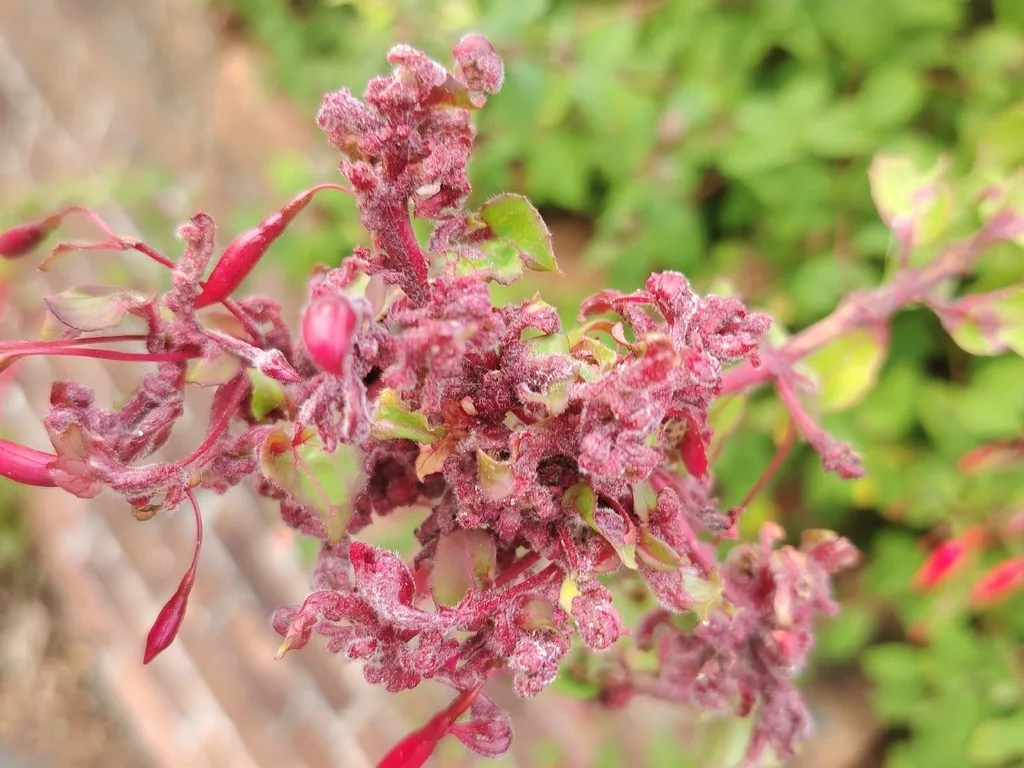
- Damage is the clue: shoot tips become a distorted mass of yellowish-green or reddish-pink tissue and leaves thicken and blister. The RHS says flowers are deformed or fail to develop, and UC IPM that flower production drops.[3][1][2]
- It's the only eriophyid mite known to damage fuchsias.[2]
Where it lives
First found in Brazil in the late 1970s, it has since turned up in California, France, Germany and the Channel Islands, and in mainland Britain in 2007; the RHS says it has spread north and into Wales, with first finds in south Wales and Cheshire in 2017. UC IPM says it is mostly a problem in coastal California and in interiorscapes, and the PNW handbook calls it primarily a problem in coastal areas. GBIF holds about 800 records, 756 of them from Great Britain and 27 from the United States.[3][2][1][7]
Biology and life cycle
Mites live and breed inside galled tissue, then move up to attack new growth and flowers.[2][1]
Each female lays about 50 eggs, and a generation takes about three weeks; there are several a year.[2]
They spread on wind, pollinating insects and birds, and on infested plants, clothing, hands and tools; EFSA names plants for planting as the main route between countries.[1][2][3][4]
RHS puts a generation at about 21 days at 18 C (64 F), with several generations from late spring to autumn. It overwinters under bud scales and may stay active through winter on greenhouse fuchsias.[3]
Fuchsia is the only known host genus. In Europe it's established in France and the UK and has been reported as transient in Belgium and Germany.[4][2]
Damage and signs
Health risk
It feeds on fuchsias, and no cited source describes any risk to people or pets.[1][2][3]
Control
Prevention
Grow less susceptible fuchsias and buy from a reliable supplier rather than swapping cuttings. RHS lists F. arborescens, F. magellanica and F. procumbens among the most susceptible, and 'Baby Chang', 'Cinnabarina', 'Miniature Jewels', 'Space Shuttle', F. thymifolia and F. venusta among the less susceptible.[1][2][3]
Sanitation
Prune or pinch off all infested growth. UC IPM says to destroy it or dispose of it away from other plants and not to compost it; the RHS suggests council waste or burying. Biological control suppliers quoted by the RHS advise cutting at least 10 cm (4 inches) below any galls before releasing predatory mites.[2][3]
Wash hands, change clothes and clean tools with alcohol after handling infested plants.[2][1]
Biological control
Predatory mites help but won't rescue the most susceptible cultivars. UC IPM points to Neoseiulus californicus, while in the UK the RHS notes Amblyseius andersoni is sold for this mite.[2][1][3]
Pesticides
After pruning, UC IPM suggests spraying what remains with a miticide labeled for the plant, or repeated horticultural oil or insecticidal soap treatments, and notes that some effective miticides are available only to licensed applicators and only for outdoor use.[2]
Does cold weather kill it?
UC IPM says warm weather reduces the mites, and leaving hardy fuchsias outdoors in cold weather may kill them.[2]
RHS notes that its cold tolerance isn't well studied; the mite may not survive below 5 C (41 F), so cold winters may clear it from hardy garden fuchsias. EFSA, by contrast, judged that climate isn't the key factor limiting its spread in Europe.[3][4]
Where it sits in mite classification
Eriophyid mites like this one are currently placed in the order Trombidiformes, which GBIF follows, but a 2017 DNA study grouped eriophyoids with the Sarcoptiformes instead, so its order may change.[6][5]
Where the sources disagree
Where it is a problem: UC IPM says coastal California and interiorscapes, the PNW handbook coastal areas, and the RHS says it is a frequent enquiry from southern England.[2][1][3]
Predatory mites: UC IPM names Neoseiulus californicus but says biological control is generally not satisfactory on the most susceptible cultivars, the PNW handbook calls predatory mites important biological control agents, and the RHS says Amblyseius andersoni is sold for this mite.[2][1][3]
Disposal: UC IPM says to destroy prunings away from plants and never compost them, while the RHS suggests council waste or burying.[2][3]
Arrival in new countries: EFSA names plants for planting as the main pathway, while the RHS says it may have reached Britain on imported pot plants or on cuttings brought back from the Channel Islands or Brittany.[4][3]
Common questions
- Why are my fuchsia's new leaves twisted and blistered?
- Fuchsia gall mites are the likely cause; the mites themselves are microscopic.[1][2]
- How do I keep fuchsia gall mite from spreading?
- Isolate infested plants, prune off damage, and wash hands and clean tools after handling them.[2]
- Which fuchsias resist gall mite?
- None are immune, but RHS lists 'Baby Chang', 'Cinnabarina', 'Miniature Jewels', 'Space Shuttle', F. microphylla subsp. hidalgensis, F. thymifolia and F. venusta as less susceptible.[3][1]
Sources
- Pacific Northwest Pest Management Handbooks (OSU, WSU, University of Idaho), “Fuchsia (Fuchsia): Fuchsia gall mite (Insect Management Handbook).” pnwhandbooks.org/insect/hort/landscape/hosts-pests-landscape-plants/fuchsia-fuchsia-fuchsia-gall-mite (accessed 2026-11-13)
- University of California Statewide IPM Program, “Fuchsia Gall Mite (Pest Notes).” ipm.ucanr.edu/home-and-landscape/fuchsia-gall-mite/ (accessed 2026-11-13)
- Royal Horticultural Society (UK), “Fuchsia gall mite.” www.rhs.org.uk/biodiversity/fuchsia-gall-mite (accessed 2026-11-13)
- EFSA Journal (EFSA Panel on Plant Health), 2014 (via PubMed), “Scientific Opinion on the pest categorisation of Aculops fuchsiae (abstract).” pubmed.ncbi.nlm.nih.gov/42087946/ (accessed 2026-11-13)
- Molecular Phylogenetics and Evolution, 2017 (via PubMed), “The phylogenetic position of eriophyoid mites (superfamily Eriophyoidea) in Acariformes inferred from the sequences of mitochondrial genomes and nuclear small subunit (18S) rRNA gene (abstract).” pubmed.ncbi.nlm.nih.gov/28119107/ (accessed 2026-11-13)
- Global Biodiversity Information Facility (GBIF), “Aculops fuchsiae Keifer, 1972 (GBIF Backbone Taxonomy).” api.gbif.org/v1/species/6914433 (accessed 2026-11-13)
- Global Biodiversity Information Facility (GBIF), “Aculops fuchsiae: occurrence records by country (GBIF occurrence search).” api.gbif.org/v1/occurrence/search?taxonKey=6914433&hasGeospatialIssue=false&occurrenceStatus=PRESENT&facet=country&facetLimit=50&limit=0 (accessed 2026-11-13). Exact count at access: 801 records (Great Britain 756; United States 27; Guernsey 5; France 4). Records reported, not abundance.