On this page
How to identify it
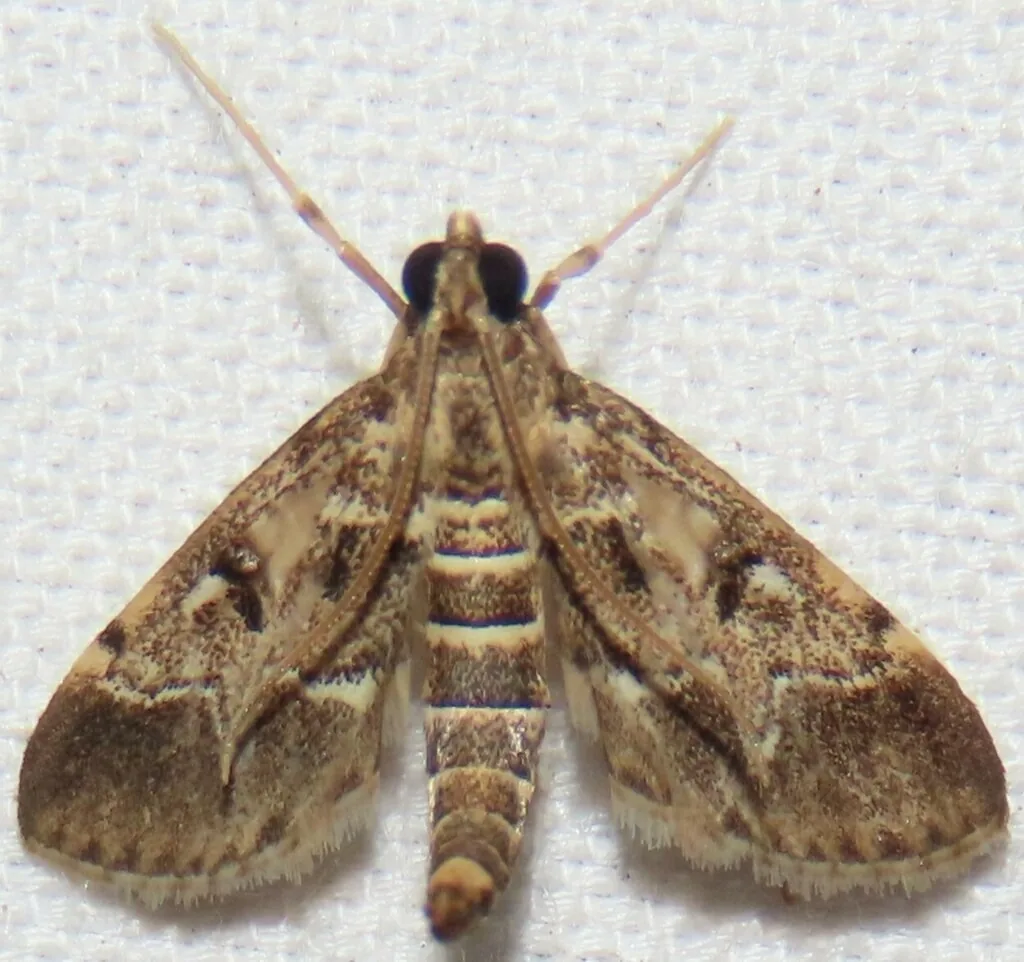
- The adult has a wingspan just under an inch and is brown and white, with a backward bend in the hindmost white wing line. UF/IFAS gives a wingspan of 19 to 21 mm (0.75 to 0.83 inch) and a body 9 to 12 mm long. The gray-brown forewings carry two yellowish-white cross lines, the outer one with a pronounced finger pointing toward the back edge, and at rest the wings form a triangle.[1][4]
- Males have white rings around a long abdomen that they hold curled up at rest. UF/IFAS says the male's abdomen curves up almost 90 degrees at rest and reaches past the wings, and adults fly low and fast with the abdomen curved upward.[1][4]
- Eggs are tiny and whitish, laid in small clusters on leaf undersides, and turn red before hatching. UF/IFAS gives eggs as 0.5 by 0.7 mm, whitish-green or straw-colored, turning pink, then red, then brown before hatching, laid singly or in overlapping masses of three to 10, mostly near the veins on leaf undersides.[1][4]
- Larvae grow to about an inch, with a dark head and creamy to brown bodies with dark spots; body color depends on what they have been eating. UF/IFAS says newly hatched larvae are 1.5 mm long with a shiny dark head and salmon-pink body, and grown larvae reach 17 to 30 mm (0.7 to 1.25 inch), turning pearly and losing their spots just before pupating.[1][4]
- UF/IFAS describes the cocoon as 15 to 19 mm of webbing, frass and soil, holding a yellow-brown pupa 9 to 12 mm long.[4]
Where it lives
Native to southern Europe and North Africa and now an invasive greenhouse pest in many countries. In North America it was first found in 2004 in San Diego County, California, and eradicated; found again in 2010, it has since been reported from 15 states. UF/IFAS says that as of December 2014, reports of established Florida populations were considered erroneous: state and UF monitoring had found no reproducing populations in the landscape, and established outdoor populations and economic damage outside greenhouses had not been confirmed in the U.S.[1][2][4]
Biology and life cycle
Larvae prefer moist spots and feed on debris as well as live plants. After about 4 weeks they pupate in a messy cocoon of silk and soil, often on leaf undersides or pot edges.[1]
At 68 degrees F the cycle takes about six weeks, allowing seven or eight generations a year in heated greenhouses; it runs faster at higher temperatures. UF/IFAS gives, at 68°F (20°C), four to nine days for eggs, three to four weeks for larvae, and one to two weeks each for pupae and adults. Females lay eggs within 24 hours of emerging and can lay 200 in a lifetime.[1][4]
In a Brazilian lab study it completed development at every temperature tested from 18 to 30 degrees C (about 64 to 86 degrees F), needing 454 degree-days above 11.7 degrees C; the authors estimated about 5.5 generations a year in strawberry-growing areas of Espirito Santo.[5]
UF/IFAS says it does not seem cold tolerant: in northern climates it is mainly a greenhouse pest that may turn up outdoors in warm months and die off in the cold. One report says it can overwinter as a pupa, and in its native range adults fly April to May and August to October, with at least two broods a year.[4]
UF/IFAS says adults are good fliers, up to about 100 km (62 miles), and larvae hidden in stems, fruit, soil and pot edges can travel on plants, fruit, herbs, vegetables and cut flowers. Larvae avoid light, and on aquatic hosts they don't seem to mind leaves being underwater.[4]
Damage and signs
- Young larvae make round or crescent holes in leaves; older ones eat whole leaves, feed below the soil, or bore into stems and fruit and girdle stems, which can kill whole plants. UF/IFAS adds that stem-boring holes can let in Botrytis, and stems may collapse suddenly without the darkening of fungal disease, sometimes before any outside damage is noticed.[1][4]
- It is a pest of greenhouse horticulture in many countries. At least 47 plant families are recorded as hosts, and in lab feeding tests larvae ate tropical houseplant species less than herbaceous and woody outdoor ornamentals.[2][3][1]
- UF/IFAS lists at least 35 plant species as hosts, from aquatic plants to crops such as pepper, tomato, celery, beets and basil and ornamentals such as poinsettia, begonia and lisianthus, plus damage records in genera including strawberries, cucumbers, squash, cyclamen and gerbera. Larvae can also breed in rose debris without harming live roses.[4]
Health risk
It feeds on plants; none of the sources mentions any risk to people.[1][3]
Control
Prevention
Remove debris and lower leaves and use drier growing media to cut the moist habitat larvae favor; this also helps sprays reach them. UF/IFAS adds that insect netting is needed in greenhouses.[1][4]
Pheromone-baited water traps are considered the best way to catch adult males, though delta and funnel traps also work. The female sex pheromone has been identified, and the full three-part blend caught the most males in field tests. UF/IFAS ranks pheromone water traps first, then delta and funnel traps, and says ultraviolet or blue light traps can also be used for monitoring.[1][2][4]
Keep them out
Inspect new plants, pots and soil surfaces for webbing and chewing, and keep new stock isolated when possible. UF/IFAS says to check where leaves meet the soil, between the soil and pot sides and in debris around the crop; cocoons turn up along the bottom edges of containers and on low leaves.[1][4]
Biological control
Bt, insect-killing nematodes, predatory beetles (Dalotia coriaria), Trichogramma egg wasps and predatory mites are commercially available natural enemies for European pepper moth. UF/IFAS lists Bt, the rove beetle and Heterorhabditis and Steinernema nematodes against larvae, and the predatory mites Stratiolaelaps scimitus and Gaeolaelaps aculeifer, the rove beetle and Trichogramma wasps against eggs.[1][4]
Pesticides
It has not shown resistance to major insecticides, and most products labeled for caterpillars work on adults, but larvae feed in sheltered spots that are hard to reach; young larvae in exposed spots are easier to kill. Check that the label covers your plant. UF/IFAS says targeted sprays work better than broad ones because of where larvae hide, contact products should go on before larvae bore into stems, and in greenhouses adults are best treated at night, when they are active.[1][4]
How many generations a year
Kentucky estimates seven or eight generations a year in year-round greenhouses at 68 degrees F. The Brazilian study, working from field temperatures in strawberry-growing areas, estimated about 5.5.[1][5]
UF/IFAS reports eight to nine generations a year in greenhouses, at a full cycle of six to eight weeks at 68°F.[4]
Where the sources disagree
Host range: Kentucky gives more than 70 host plants, while UF/IFAS lists at least 35 species plus damage records in other genera.[1][4]
U.S. status: Kentucky says it has been found in 15 states; UF/IFAS says a 2014 report listing it as established in Florida and other states gave no citation, and that Florida reports were considered erroneous as of December 2014.[1][4]
Common questions
- What's chewing my potted plants down at the soil line?
- European pepper moth larvae can feed below the soil surface and girdle stems, mostly on container plants.[1]
- Is European pepper moth only a pepper pest?
- No; it has been recorded on more than 70 host species in at least 47 plant families.[1][3]
- How do growers monitor for it?
- With traps baited with the female sex pheromone; water traps catch the most males.[1][2]
- Is European pepper moth established in Florida?
- Not as of UF/IFAS's December 2014 update: extensive state and UF monitoring had found no reproducing populations in the landscape, and suspected outdoor populations should be reported to the state plant industry division or UF.[4]
Sources
- University of Kentucky Entomology (ENTFACT), “European Pepper Moth (ENTFACT-324).” entomology.mgcafe.uky.edu/ef324 (accessed 2026-11-14)
- Journal of Chemical Ecology, via PubMed, “Identification of the female-produced sex pheromone of an invasive greenhouse pest, the European pepper moth (Molnar et al. 2018).” pubmed.ncbi.nlm.nih.gov/29376213/ (accessed 2026-11-11)
- Environmental Entomology, via PubMed, “Differential feeding on ornamental plants by Duponchelia fovealis larvae (Copeman & Frank 2024).” pubmed.ncbi.nlm.nih.gov/38493297/ (accessed 2026-11-11)
- University of Florida IFAS Extension (EDIS), “European Pepper Moth or Southern European Marsh Pyralid, Duponchelia fovealis (Zeller), EENY-508/IN910 (Featured Creatures).” ask.ifas.ufl.edu/publication/IN910 (accessed 2026-11-14)
- Anais da Academia Brasileira de Ciencias, via PubMed, “Thermal requirements, development and number of generations of Duponchelia fovealis (Paes et al. 2018).” pubmed.ncbi.nlm.nih.gov/30133577/ (accessed 2026-11-11)
- iNaturalist, “Duponchelia fovealis taxon page (order and family).” www.inaturalist.org/taxa/371745 (accessed 2026-11-11)