On this page
How to identify it
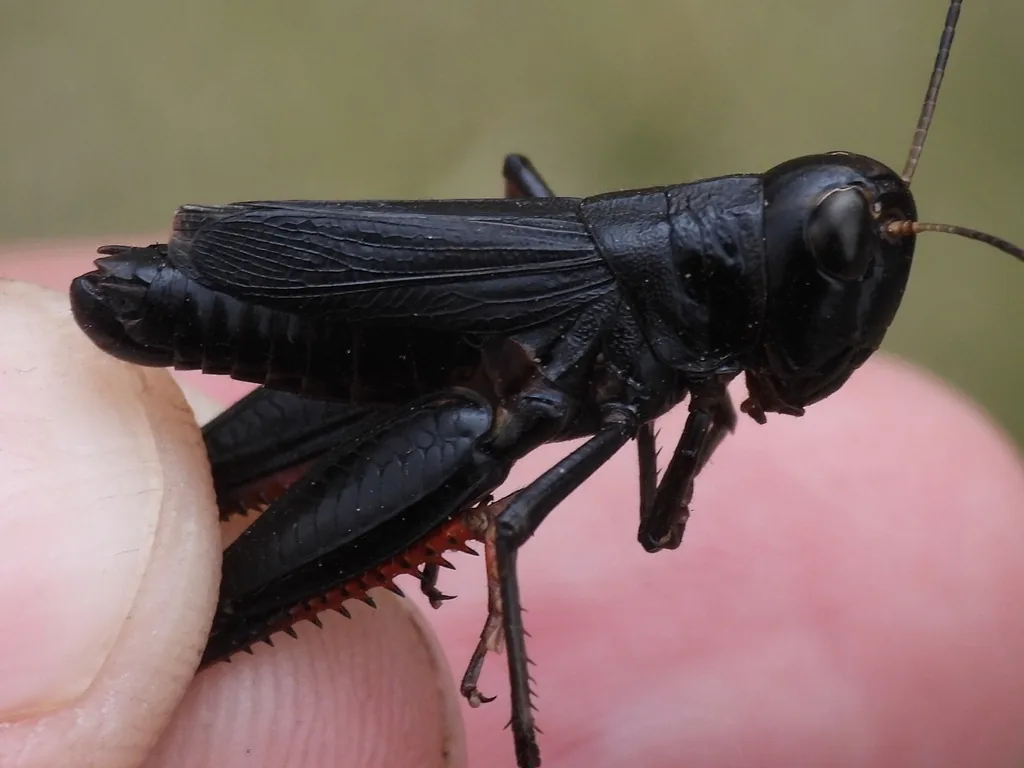
- Males are strikingly black, 20 to 23 mm long, with working wings that reach nearly to the tip of the abdomen. A black male is more likely to be mistaken for a cricket than for another grasshopper.[1][2]
- Females are much bigger, 34 to 38 mm long, and light brown with light and dark markings. Their forewings usually cover only about half the abdomen and cannot carry them; a few females have long wings, and a few are dark brown or black.[1][2]
- The hind wing has a dark outer end, though the sources describe the rest of it differently (see where the sources disagree). Hind shins vary from black to red in males and from pale or pinkish to red or purple in females.[1][2]
- Nymphs have a wide tan band down the back and a pale yellow underside.[1]
Look-alikes
| Look-alike | How to tell them apart |
|---|---|
| Boopedon gracile | Females of this related species look much like ebony grasshopper females; the spots on the forewings tell them apart.[2] |
Where it lives
Ranges through western grasslands from Montana to Mexico; USDA ARS lists mixedgrass, shortgrass, sand and desert prairie, favoring the lusher stands (see where the sources disagree on habitat). In Nebraska it is limited to the southwest and the Panhandle.[1][2]
Biology and life cycle
It eats grasses (see where the sources disagree on how choosy it is). Blue grama made up most of its diet in southwestern Texas and western wheatgrass most of it in central Nebraska; Nebraska Extension also names needleandthread as a preferred grass. It climbs a leaf, bites through it and eats the whole cut piece rather than dropping it.[1][2]
Eggs overwinter in pods laid in bare soil between grass clumps. In eastern Colorado and western Kansas they hatch from late May through the first half of June, two to three weeks after the migratory grasshopper. In Arizona hatching waits for summer rain, beginning about ten days after a soaking.[1]
Nymphs pass through five stages in about 40 days in Colorado, and in as little as 27 to 31 days in Arizona. Adults are most common from late July to September.[1][2]
Because most females cannot fly, populations usually stay put, but whole populations can move on foot. In Arizona, after stripping their habitat in dry years, they marched across low hills to fresh forage.[1]
A parasitic fly larva, Neorhynchocephalus sackenii, feeds inside the grasshopper, stops females from producing eggs and kills its host. In a ten-year Arizona study it apparently held the population down in six of the ten years.[1]
Damage and signs
- At high densities it damages rangeland forage, usually as one of several abundant grasshopper species. Outbreaks are most frequent in the southern mixedgrass and desert prairies of Arizona, New Mexico and western Kansas, Oklahoma and Texas, and can last several years.[1][2]
- Western Oklahoma had a severe outbreak in 1955 and another from 1973 to 1979 over 1.5 million acres of prairie, with the ebony grasshopper prominent in both. In Arizona's San Rafael Valley in 1956, a mixed grasshopper population including this species cost an estimated 600 pounds of dry forage per acre.[1]
- In Arizona it has also been found in corn, sorghum and wheat.[1]
Health risk
The sources cover it only as a grass-eating rangeland grasshopper and describe no risk to people.[1][2]
Control
Prevention
In Nebraska it is unlikely to be a pest. On rangeland, Utah State says the condition and forage value of the range must be weighed against the potential damage to decide whether control is justified.[2][3]
Biological control
Natural enemies matter: a parasitic fly apparently held down an Arizona population in six years of a ten-year study, and Utah State says a combination of predators, parasites and pathogens contributes to grasshopper control every year.[1][3]
Pesticides
Insecticide treatment sharply reduced an Arizona population in 1956. Utah State notes that because grasshoppers are so mobile, area-wide treatments may only reduce populations for that year, and it encourages ranchers to scout for the hot spots where egg laying concentrates and outbreaks first start.[1][3]
Where the sources disagree
Hind wing: USDA ARS describes the disk as pale blue with a black tip; Nebraska Extension says the hind wing is clear and blackish on the outer half.[1][2]
Habitat: USDA ARS lists mixedgrass, shortgrass, sand and desert prairie; Nebraska Extension gives shortgrass prairie.[1][2]
Diet: USDA ARS says it is more discriminating than most grass-feeding grasshoppers and notes that western wheatgrass dominated its diet in Nebraska but was refused in Wyoming tests; Nebraska Extension says it eats a wide variety of grasses and prefers western wheatgrass, needleandthread and blue grama.[1][2]
Common questions
- Are the black grasshoppers and the brown short-winged ones in my pasture the same species?
- They can be. Male ebony grasshoppers are solid black and long-winged, while females are larger, light brown and usually short-winged.[1][2]
- Can ebony grasshoppers fly?
- Males fly swiftly. Most females cannot, but populations can still migrate by walking when food runs short.[1]
Sources
- USDA Agricultural Research Service, Northern Plains Agricultural Research Laboratory, “Ebony Grasshopper, Boopedon nubilum (Say): species fact sheet, Grasshoppers: Their Biology, Identification and Management.” www.ars.usda.gov/plains-area/sidney-mt/northern-plains-agricultural-research-laboratory/pest-management-research/pmru-docs/grasshoppers-their-biology-identification-and-management/id-tools-apps/fact-sheets/gomphocerinae-subfamily/fs-ebony/ (accessed 2026-11-13)
- University of Nebraska-Lincoln Extension, “The Grasshoppers (Orthoptera: Acrididae and Romaleidae) of Nebraska, EB3 (M. L. Brust, W. W. Hoback and R. J. Wright).” extensionpubs.unl.edu/publication/eb3/2009/pdf/view/eb3-2009.pdf (accessed 2026-11-13)
- Utah State University Extension, “Grasshoppers (E. Evans and E. Hodgson, June 2008).” extension.usu.edu/planthealth/research/grasshoppers (accessed 2026-11-13)
- Global Biodiversity Information Facility (GBIF), “Boopedon nubilum (Say, 1825) (GBIF Backbone Taxonomy).” api.gbif.org/v1/species/1706031 (accessed 2026-11-13)
- iNaturalist, “Boopedon nubilum taxon page (order and family).” www.inaturalist.org/taxa/215311 (accessed 2026-11-09)