On this page
How to identify it
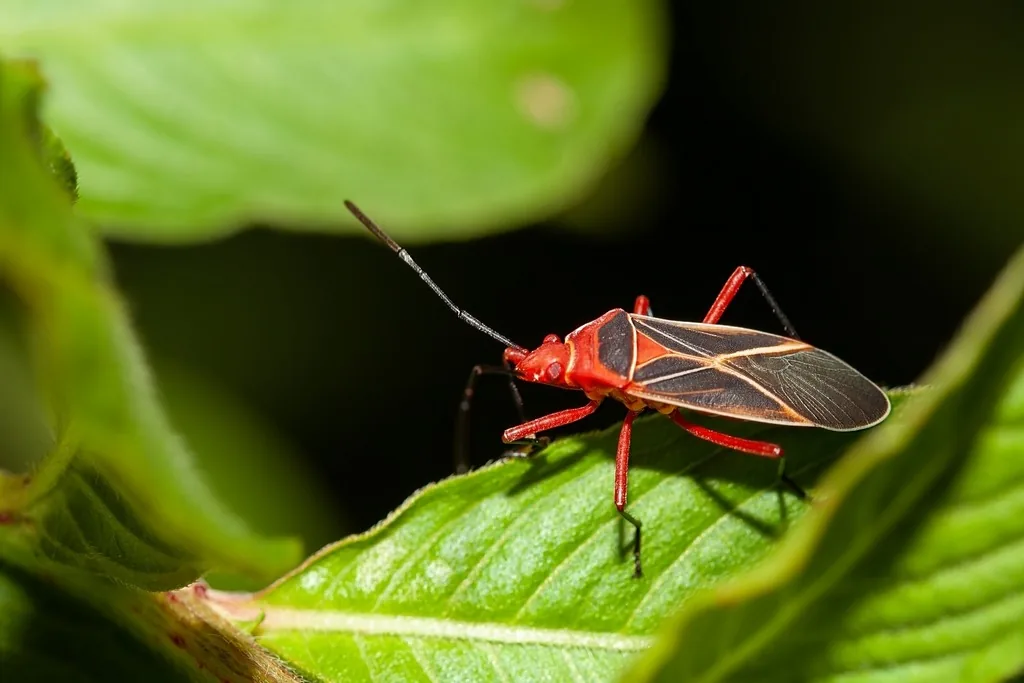
- Adults are 12 to 17 mm long. In the Florida Division of Plant Industry key, the leathery part of the front wing (the corium) is light to dark brown rather than red and has no round black spot, though a dark bar is sometimes present.[1]
- The first antennal segment is distinctly longer than the second, which is about 7/10 its length. That separates it from the smaller Dysdercus mimulus, whose first two segments are about equal.[1]
- Eggs look like microscopic hens' eggs and are laid singly or in small, loose clusters in sand, debris or decaying plant matter. UF/IFAS says they are pale yellow and hatch in about one week.[1][2]
- There are five nymphal stages. Nymphs are generally red; the last two stages have dark wing pads, and the lines between the abdominal segments become very distinct as they near adulthood.[1]
- UF/IFAS describes the adult as narrow and long-legged, around 3/5 inch long, with a bright red thorax and brown wings crossed with yellow.[2]
Look-alikes
| Look-alike | How to tell them apart |
|---|---|
| Dysdercus andreae | Under 12.5 mm long, with red or reddish-orange front wings whose pale edges form a St. Andrew's cross, a black bar near the wing membrane and a contrasting pale yellow collar on the thorax. It ranges from southern Florida through most of the Antilles. UF/IFAS notes a Florida plant-industry record of royal poinciana severely damaged by this species.[1][2] |
| Dysdercus mimulus | Smaller, 10 mm or less, with the first two antennal segments about equal in length. It ranges from southern Florida, Texas and Mexico into Central America and the West Indies.[1] |
Where it lives
The Florida Division of Plant Industry described it in 1966 as most common in southern Florida and Cuba and also reported from Jamaica, Puerto Rico, Alabama, Georgia and South Carolina, but scarce in north Florida and presumed rare in those three states. Public records agree: nearly all of GBIF's about 1,200 U.S. records since 1990 come from Florida, with a few from Cuba and the Cayman Islands. UF/IFAS repeats this range and adds that a fourth, undetermined Dysdercus is known in the U.S. only from two specimens taken at Key Largo and Homestead.[1][3][4][2]
Biology and life cycle
Development is quick in summer. Each of the first four nymphal stages typically lasts four to five days in midsummer, the fifth takes about twice as long, and the first stage is usually spent underground. UF/IFAS says all five stages take 21 to 35 days.[1][2]
There are several generations a year, and the life cycle runs from about a month to three and a half months, depending mainly on temperature. Cotton stainers are attracted to lights.[1]
Cotton stainers carry gut parasites. The trypanosomatid Leptomonas seymouri was first described from this species, and a 2024 survey of insects in Cuba confirmed Dysdercus bugs as its natural hosts.[5][6]
Damage and signs
- The name comes from staining cotton lint an indelible brownish yellow. Most authorities say the stain comes from juice that oozes when the bug punctures seeds in developing bolls, though a few blamed its excrement. Feeding on flower buds and young bolls can also stunt them or make them drop.[1]
- It was once called the most destructive cotton pest in Florida, but lost that importance as cotton waste that served as breeding and overwintering sites was cleaned up, chemical controls improved and cotton acreage shrank. UF/IFAS says it is now only a minor cotton pest, and then only in southern Florida, even though cotton planting rebounded from the mid-1990s, with 109,000 acres planted in northern Florida in 2003.[1][2]
- It has also been a severe pest of oranges. According to an 1885 report, a single puncture can make an orange drop within a few hours and decay in one or two days, and old reports describe whole crops lost.[1]
- Other recorded hosts include tangerines, okra pods, ripe papaya, oleander pods and blossoms, roselle (Jamaica sorrel) pods, tree hibiscus, Turk's cap, Sida, Caesar's weed, Spanish needle, portia tree, rose buds and blossoms, eggplant, nightshade and guava.[1]
- Today, UF/IFAS says, it matters mainly for its presence on and occasional damage to fruits and ornamentals, especially mallow-family plants such as hibiscus. On cotton, feeding on flower buds or young bolls usually stunts them or makes them drop.[2]
Health risk
Cotton stainers feed on plants, and the Florida plant-industry circular treats them only as plant pests. Researchers studying their gut parasites note that Leptomonas seymouri is known to rarely infect humans, but none of these sources reports cotton stainers biting people or passing the parasite to them.[1][6]
Control
Keep them out
A band of sticky barrier material around tree trunks keeps young bugs from crawling up to fruits and blossoms.[1]
Sanitation
Don't leave cotton, cottonseed or other host-plant debris on the ground, where it gives the bugs places to breed.[1]
Traps and physical control
Small heaps of seeds, fruit or bits of sugarcane can be set out as bait to gather the bugs, which the Florida circular then killed with scalding hot water.[1]
For small infestations, UF/IFAS says colonies on plants can be shaken into a bucket of soapy water.[2]
Pesticides
Insecticides can be used on ornamentals and fruits, but follow the dosages and pre-harvest waiting periods on the label for edible fruit. The 1966 circular noted that control information for cotton stainers on ornamentals was very limited. UF/IFAS still describes management information for Dysdercus on ornamentals in Florida as very limited.[1][2]
Where the sources disagree
Killing bugs gathered at baits: the 1966 Florida circular used scalding hot water, while UF/IFAS says to kill them with a spray of soapy water.[1][2]
Common questions
- What are the red and black bugs on my hibiscus?
- In south Florida, red nymphs and brown-winged adults clustered on hibiscus and related plants are likely cotton stainers. Two smaller Dysdercus species also occur there and can be told apart by size, wing color and antennae.[1]
- How do I get rid of them?
- Clean up fallen host-plant debris, band tree trunks with sticky barrier material, and gather the bugs at small baits of seeds or fruit so you can destroy them. For a few colonies, UF/IFAS suggests shaking them into a bucket of soapy water.[1][2]
- Are cotton stainers harmful to people?
- They are plant feeders, and the sources describe no bites. A gut parasite they carry, Leptomonas seymouri, has rarely been found infecting people, but no source here links that to contact with the bugs.[1][6]
Sources
- Florida Department of Agriculture, Division of Plant Industry (copy hosted by the Florida State Collection of Arthropods), “Cotton Stainers, Dysdercus spp., in Florida (Entomology Circular 48, F. W. Mead, 1966).” thefsca.org/wp-content/uploads/1966/05/ent048.pdf (accessed 2026-11-11)
- University of Florida IFAS Extension (EDIS), “Cotton Stainer, Dysdercus suturellus (Herrich-Schaeffer), EENY330/IN606 (Featured Creatures; F. W. Mead and T. R. Fasulo).” ask.ifas.ufl.edu/publication/IN606 (accessed 2026-11-14)
- Global Biodiversity Information Facility (GBIF), “Dysdercus suturellus: U.S. occurrence records since 1990 by state (GBIF occurrence search).” api.gbif.org/v1/occurrence/search?taxonKey=2012177&country=US&hasGeospatialIssue=false&occurrenceStatus=PRESENT&year=1990%2C2026&facet=stateProvince&facetLimit=400&limit=0 (accessed 2026-11-11). Exact count at access: 1,208 U.S. records since 1990 (Florida 1,206).
- Global Biodiversity Information Facility (GBIF), “Dysdercus suturellus: occurrence records since 1990 by country (GBIF occurrence search).” api.gbif.org/v1/occurrence/search?taxonKey=2012177&hasGeospatialIssue=false&occurrenceStatus=PRESENT&year=1990%2C2026&facet=country&limit=0 (accessed 2026-11-11). Exact counts at access: 1,229 records since 1990; United States 1,208, Cuba 8, Cayman Islands 7.
- Journal of Protozoology, via PubMed, “Leptomonas seymouri sp. n. from the cotton stainer Dysdercus suturellus (Wallace 1977).” pubmed.ncbi.nlm.nih.gov/599500/ (accessed 2026-11-11)
- Parasitology, via PubMed, “Multiple and frequent trypanosomatid co-infections of insects: the Cuban case study (Votypka et al. 2024).” pubmed.ncbi.nlm.nih.gov/38616408/ (accessed 2026-11-11)
- iNaturalist, “Dysdercus suturellus taxon page (order and family).” www.inaturalist.org/taxa/326190 (accessed 2026-10-06)