On this page
How to identify it
- Soldiers are small, about 5 mm, with a dark brown, cone-shaped head that comes to a point instead of large jaws. They are hard to identify with the naked eye, but their tunnels are easy to see. UF/IFAS calls the cone a nasus, says the soldiers' jaws are reduced to small points, and notes that six hairs on the soldier's head, together with colonies having several queens, help separate it from some other Nasutitermes species.[2][1][7]
- The soldier's cone secretes a sticky, pine-sap-like chemical used against ants, lizards and termites from other colonies. Cooperative Extension says about 20% of a colony are soldiers, a higher share than in other termites.[1][2]
- Swarmers (alates) have dark brown bodies and dark brown wings and measure 15 to 18 mm including the wings. UF/IFAS adds that two thickened veins run along the leading edge of the wings.[2][7]
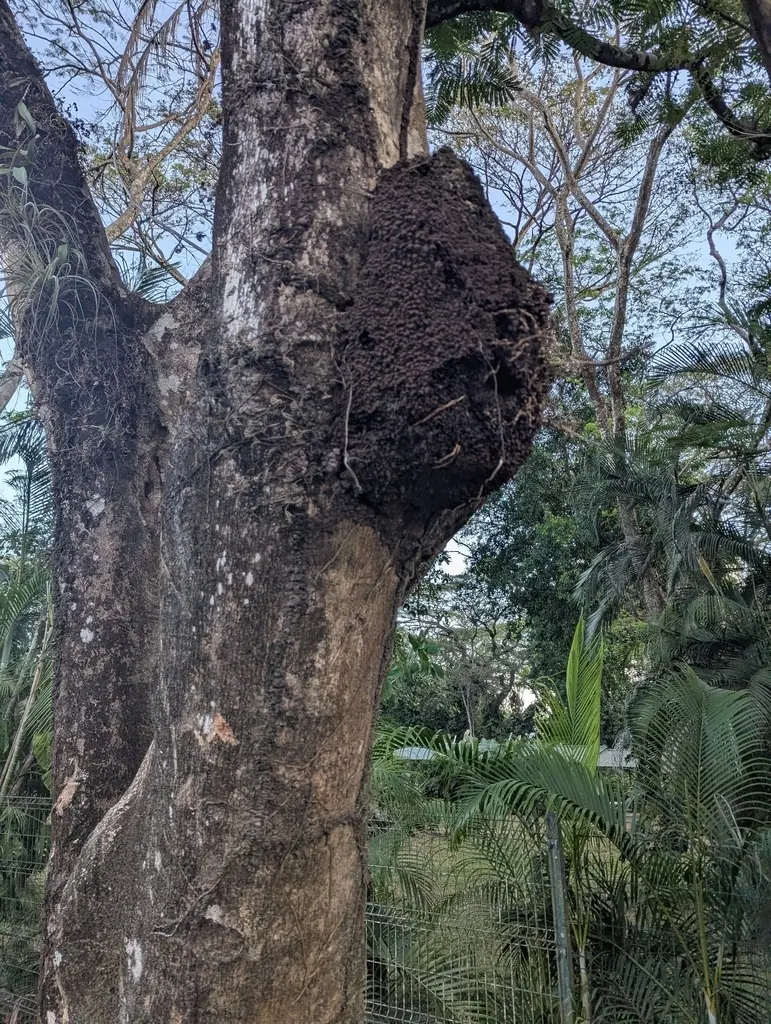
- Nests are dark brown to black, hard and bumpy, up to 3 feet in diameter, and look like a ball of mud but are made of termite feces. A young colony's first nest is about the size of a fist and can reach the size of a watermelon in a few months.[2][3]
- Foraging tunnels are narrow and brown, usually ½ inch wide or less, and run up the sides of trees, houses and fences and across the ground. A broken active tunnel shows soldiers and workers.[1][2]
Look-alikes
| Look-alike | How to tell them apart |
|---|---|
| Florida dark-winged subterranean termite | Its swarmers also have dark bodies and dark wings, but conehead swarmers, at 15 to 18 mm including the wings, are much larger. UF/IFAS says these are the only two Florida termites with dark-winged adults, and gives about 9 mm (0.35 inch) including the wings for the dark-winged subterranean termite, roughly half the conehead's 15 to 18 mm.[2][7] |
| Subterranean termites | Subterranean termites tunnel underground, while conehead termites usually build visible nests above ground and tunnel across surfaces.[2] |
| Drywood termites | Drywood termites stay hidden inside the wood they infest, while conehead termites build exposed nests and surface tunnels.[2] |
Where it lives
Native to Central America, most of South America and the Caribbean, and invasive in New Guinea and Florida. In the U.S. it was first found in Dania Beach, Broward County, in 2001, and a second infestation turned up in Pompano Beach in 2016, about 21 km to the north; genetic study shows both came from a single introduced colony. UF/IFAS adds that it was first described from Panama, that its native range reaches north to Mexico, and that it establishes in urban, agricultural and natural habitats; it was the first non-native member of its family, Termitidae, recorded as established in the United States.[4][3][1][5][7]
Biology and life cycle
It probably arrived on a boat that had traveled through its native range and docked at a marina in Dania Beach, near Fort Lauderdale.[2][4][5]
Nests sit at the base of trees or on branches, hidden in vegetation, on open ground, in debris, in or on structures, trash piles or cement blocks. FDACS photos show nests at the base of an oak and in a sabal palm. UF/IFAS says the nests are carton made mostly of feces, and some are hard to find under vegetation or debris.[2][1][7]
Colonies with several kings and queens are common; FDACS counted 196 queens in one Florida nest, and nests can double in size in one month. Colonies may also build satellite nests near a structure.[2][4]
When a colony reaches about 50,000 workers and soldiers it sends out swarmers to start new colonies, and a large colony holds about 800,000 to 1.2 million termites. UF/IFAS says mature colonies swarm every year in the rainy season, May to November, usually after rain.[2][7]
A young queen and king start the colony hidden inside wood, and it can be several years before it builds tunnels and a visible nest. Most of the spread in Broward County came from swarming flights, but moves from city to city came from people carrying infested material.[4][3]
In 2024 and 2025 FDACS crews found nests partly or completely underground along a canal in Dania Beach and Fort Lauderdale; 37 such nests were removed and treated in 2025, and the authors note the species can nest at least 55.9 cm (22 in) below ground.[3]
Foraging tunnels are hollow, about 5 mm (0.2 in) wide or wider, look like a straw when broken, and form highly branched networks that can easily reach more than 30 m from a nest.[7]
Soldiers leave the nest at night to find food and then recruit workers; once a trail is set, the termites cover it with a mix of soil and feces. Workers come in two sizes: the large ones are female and the small ones male.[7]
Beyond the founding pair, UF/IFAS says colonies can hold adultoids, winged adults that shed their wings in the home nest and stay to reproduce, which have been seen to number up to 33, plus replacement reproductives that lay fewer eggs and usually appear after a founder dies or is cut off. Isolated satellite nests can bud off as separate colonies.[7]
Damage and signs
- It eats dry and moist wood, including load-bearing lumber, framing and trim, as well as dead and decaying wood, bamboo, palm leaf bases, paper and cardboard. UF/IFAS adds that it eats both hard and soft wood, including decayed wood, and that its surface tunnels are usually more numerous and easier to spot than the nests.[2][1][7]
- FDACS calls it a structural and agricultural pest that can infest buildings and landscapes quickly; it feeds on dead bark of live or dead trees, shrubs, grasses, roots and furniture. UF/IFAS calls it an aggressive structural pest that eats dead parts of live trees, including fruit trees.[1][7]
- In a Broward County mangrove forest it has heavily damaged red and white mangroves and native palms, deep in the trunks and high into the canopy, and FDACS warns it could disrupt natural areas such as the Everglades if it spreads.[4]
Health risk
The concern is damage to wood, landscapes and natural areas; none of these sources reports a health risk to people. Soldiers defend the colony with a sticky secretion from the cone on the head.[1][2][4]
Control
Prevention
Don't move trees, wood debris, pallets, railroad ties or cardboard boxes out of infested areas: people carrying hidden colonies in such material is how the termite has jumped from city to city.[4]
Traps and physical control
FDACS's field protocol is to survey for nests and tunnels, pull out and crush the nest, and immediately treat the crushed nest material and the wood, rock or cement bordering the nest with targeted insecticides, then keep monitoring in case reproductives escape and rebuild.[3][1]
Pesticides
Conehead termites do not respond to borate-based treatments.[2]
UF/IFAS says that because the nests are usually visible, treatment with non-repellent liquid termiticides is effective, and cites researchers who suggest treating the foraging tubes and earlier feeding sites. Heavy structural infestations may also be fumigated.[7]
When to call a professional
Report suspected conehead nests or tunnels to the FDACS Division of Plant Industry Helpline at 1-888-397-1517, or email a photo to DPIHelpline@FDACS.gov. FDACS runs the Conehead Termite Eradication Program, which surveys and treats two areas of Broward County.[1]
Standard subterranean and drywood termite treatments won't work against this species; Cooperative Extension advises working with an experienced, licensed pest management professional.[2]
UF/IFAS says infestations in occupied buildings are easy to detect and can be treated if the species is correctly identified and all the nests are found. Plan on periodic follow-up surveys, because young colonies can stay hidden inside wood for several years.[7]
Where sources disagree
Underground activity: Cooperative Extension says conehead termites do not tunnel underground, and FDACS describes them as nesting in trees. A 2025 paper by FDACS staff reports nests and tunnels below ground as common at two canal-bank sites in Broward County, while finding no such nests at other infested sites. UF/IFAS describes ground nests as common too.[2][1][3][7]
Native range: UF/IFAS gives Mexico through Central and South America and the West Indies, with an introduction to the Papuan Region; FDACS gives Central America, most of South America and the Caribbean, with New Guinea and Florida as invaded areas.[7][4]
Regulation and eradication in Florida
FDACS reports that the USDA lists the genus Nasutitermes and this species in the U.S. Regulated Plant Pest Table, so their importation is regulated and quarantinable. USDA data show Nasutitermes termites were intercepted 122 times in 19 states between 1984 and 2019, 21 of them conehead termites.[4]
Of 136 Broward County properties that have had conehead termites, FDACS reported in 2022 that 13, covering about 12 acres, were still known to be infested and 123 were under control and being monitored for young colonies. FDACS currently surveys and treats two areas, around Dania Beach and Pompano Beach.[4][1]
Common questions
- Why is it called a conehead termite?
- The soldiers have a pointed, cone-shaped head that squirts a sticky defense chemical. It used to be called the tree termite, but the name was changed because it nests in many places besides trees.[2][1]
- What should I do if I find a conehead termite nest?
- Report it right away to the FDACS Division of Plant Industry Helpline (1-888-397-1517 or DPIHelpline@FDACS.gov), which runs the state's eradication program, and don't move the nest or infested wood.[1][4]
- Can conehead termites be eliminated from a building?
- UF/IFAS says infestations can be treated if the species is correctly identified and every nest is found, but follow-up surveys are needed because young colonies can hide inside wood for several years. In Florida, report suspected nests to FDACS first.[7][1]
Sources
- Florida Department of Agriculture and Consumer Services, “Conehead Termite Eradication Program.” www.fdacs.gov/Consumer-Resources/Health-and-Safety/Protect-Your-Home-from-Pests/Termites/Conehead-Termite-Eradication-Program (accessed 2026-11-11)
- Cooperative Extension (eXtension Foundation), “How to Get Rid of Conehead Termites (Pests in the Home).” pestsinthehome.extension.org/termites/how-to-get-rid-of-conehead-termites/ (accessed 2026-11-11)
- Insects, via PubMed, “Underground Nests and Foraging Activity of Invasive Conehead Termites (Nasutitermes corniger) (Thorne, Tenn, Alspach, Roden and Clark 2025; full text via PMC).” pubmed.ncbi.nlm.nih.gov/41465699/ (accessed 2026-11-11)
- Florida Department of Agriculture and Consumer Services, “Invasive Conehead Termites: Continued Risk of Introductions and Spread of Destructive Pests (Alspach, Thorne, Tenn and Clark; ECISMA Newsletter vol. 12, 2022).” ccmedia.fdacs.gov/content/download/116900/file/invasive-conehead-termites-continued-introductions-and-spread-of-destructive-pests.pdf (accessed 2026-11-11)
- Journal of Economic Entomology, via PubMed, “Genetic Analysis of Invasive Conehead Termites (Blattodea: Termitidae) Reveals a Single Origin for Two Populations in Florida (Thorne et al. 2019).” pubmed.ncbi.nlm.nih.gov/31504695/ (accessed 2026-11-11)
- iNaturalist, “Nasutitermes corniger taxon page (order and family).” www.inaturalist.org/taxa/122701 (accessed 2026-10-06)
- University of Florida IFAS Extension, EDIS (Featured Creatures), “Conehead Termite, Nasutitermes corniger (Motschulsky), EENY-745/IN1275 (Featured Creatures).” ask.ifas.ufl.edu/publication/IN1275 (accessed 2026-11-14)