On this page
How to identify it
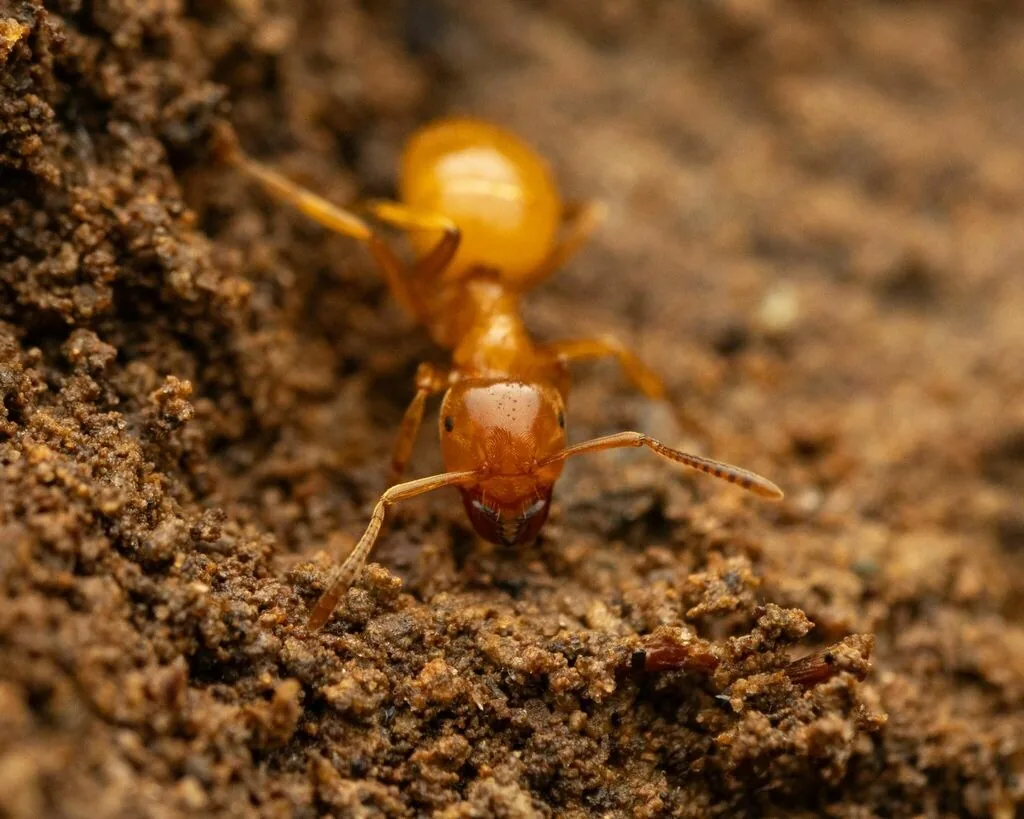
- Workers are yellow to yellow-orange and give off a lemony, citronella-like odor when the colony is disturbed or an ant is crushed.[1][2]
- Sizes vary by source: Penn State gives larger yellow ant workers as 4 to 4.5 mm long and smaller yellow ant workers as 3 to 4 mm, while Minnesota Extension gives yellow ant workers as about 3/16 inch and queens about 5/16 inch. Workers have a single node in the waist.[1][3]
- Two species go by this name; the larger yellow ant, Lasius interjectus, is the one most often found in homes, so this page uses it as the main example.[1]
- Swarmers are about twice the size of workers and have smoky-colored wings; see where the sources disagree on their color.[1][2]
Look-alikes
| Look-alike | How to tell them apart |
|---|---|
| Subterranean termite swarmers | Ant swarmers have a pinched waist, elbowed antennae, and two long and two shorter wings; termite swarmers have straight-sided bodies and four equal-length wings.[4] |
| Odorous house ant | Odorous house ants are dark brown to black and smell like rotten coconut when crushed, not lemon.[2] |
Where it lives
Both species occur throughout much of the continental United States and are very common in the East. GBIF's U.S. records of the larger yellow ant run coast to coast, most from New York, Maryland, Pennsylvania, Virginia, North Carolina and Ohio.[1][5]
Biology and life cycle
They live underground and feed on honeydew from aphids and mealybugs feeding on shrub roots. Penn State says they are not known to forage for other food; Minnesota Extension says they rarely take other sweets.[1][2][3]
Nests are found in open woods, fields, gardens, lawns, next to foundations, and under slabs, large rocks, patio blocks and rotting logs.[1][2]
Swarming season varies by source (see where the sources disagree). Penn State, Minnesota and Nebraska all say swarms can appear indoors in winter or other odd seasons, likely because soil under heated slabs stays warm.[1][3][2]
A swarming event usually lasts a few days and then stops until the following year.[2]
Damage and signs
Health risk
Penn State, Minnesota and Nebraska Extension treat citronella ants as a nuisance and don't mention any risk to people or pets.[1][3][2]
Control
Keep them out
Swarmers usually get in through expansion cracks in slabs or gaps around doors, so sealing those openings limits indoor sightings.[1]
Traps and physical control
Vacuum up swarmers or remove them by hand; Nebraska Extension says this may need repeating daily for about a week, since a swarming event usually lasts a few days. Texas A&M says that if you see no other sign of ants than occasional swarmers, no further control may be needed.[2][3][4]
Pesticides
Large indoor swarms can be knocked down with an aerosol insecticide labeled for flying insects, such as pyrethrins. Baits do not work on swarms, because the colony is not foraging then, and since workers rarely forage indoors, indoor treatment is not warranted. Minnesota Extension adds that finding nests under slabs is difficult and control there is not practical or needed.[3][2]
If swarms keep returning, locate the colonies by the soil mounds around their openings; outdoor nests can be treated by injecting or drenching an insecticide into them.[1][2]
When to call a professional
Many ant insecticides can be used only by licensed applicators, so Penn State suggests a professional for repeat swarms; for a persistent colony under a foundation, a pest management professional may do a sub-slab injection.[1][2]
Where the sources disagree
Name: Penn State and Minnesota Extension call the larger yellow ant Lasius interjectus, and Minnesota notes it was formerly Acanthomyops interjectus; the GBIF backbone taxonomy still treats Lasius interjectus as a synonym of Acanthomyops interjectus.[1][3][6][7]
Worker size: Penn State gives larger yellow ant workers as 4 to 4.5 mm; Minnesota gives yellow ant workers as about 3/16 inch; Nebraska gives larger yellow ant workers as about 1/4 inch (6 to 7 mm).[1][3][2]
Swarmer color: Penn State says light yellow to light reddish-brown; Minnesota says yellowish to reddish-brown; Nebraska says yellowish-brown to black.[1][3][2]
Swarming season: Penn State says swarming is most common in mid- to late summer; Minnesota gives April through September; Nebraska says they swarm nearly any time of the year.[1][3][2]
Food: Penn State says they are not known to forage for anything but honeydew; Minnesota says they eat honeydew and rarely other sweets.[1][3]
Common questions
- Are the winged insects coming out of my basement floor termites?
- Check the waist and antennae. Ants have a pinched waist and bent antennae, while termites are straight-sided with equal-length wings. Yellow ants with a lemon smell are citronella ants.[4][1]
- Do citronella ants damage homes?
- No. They won't reproduce indoors or attack stored goods or wood, though soil they dig out from under a slab can come up through cracks.[1][2]
- Why do they smell like lemons?
- They release a lemon verbena or citronella odor when threatened, and it is most noticeable when the ants are crushed.[1]
- Will citronella ants get into my food?
- They are not a food pest: they live on honeydew from root-feeding aphids and mealybugs, Penn State says they are not known to forage for other food and calls them only a nuisance, and Minnesota says they rarely take other sweets.[1][3]
Sources
- Penn State Extension, “Citronella Ants (updated May 12, 2026).” extension.psu.edu/citronella-ants (accessed 2026-11-13)
- University of Nebraska-Lincoln Extension, “Identification of Structure-Invading Ants in Nebraska (EC1570, revised October 2023).” extensionpubs.unl.edu/publication/421/pdf/view (accessed 2026-11-13)
- University of Minnesota Extension, “Ants.” extension.umn.edu/insects-infest-homes/ants (accessed 2026-11-13)
- Texas A&M AgriLife Extension, “Swarming Insects Indoors (ENT-2012).” citybugs.tamu.edu/factsheets/landscape/ants/ent-2012/ (accessed 2026-11-13)
- Global Biodiversity Information Facility (GBIF), “Lasius interjectus: U.S. occurrence records since 1990 by state (GBIF occurrence search).” api.gbif.org/v1/occurrence/search?taxonKey=7711934&country=US&hasGeospatialIssue=false&occurrenceStatus=PRESENT&year=1990%2C2026&facet=stateProvince&facetLimit=400&limit=0 (accessed 2026-11-13). Exact count at access: 1,219 U.S. records since 1990 from 43 states (New York 136; Maryland 105; Pennsylvania 99; Virginia 96; North Carolina 94; Ohio 94; Massachusetts 89).
- Global Biodiversity Information Facility (GBIF), “Acanthomyops interjectus (Mayr, 1866) (GBIF Backbone Taxonomy).” api.gbif.org/v1/species/1323765 (accessed 2026-11-13)
- Global Biodiversity Information Facility (GBIF), “Lasius interjectus Mayr, 1866 (homotypic synonym) (GBIF Backbone Taxonomy).” api.gbif.org/v1/species/7711934 (accessed 2026-11-13)
- Global Biodiversity Information Facility (GBIF), “Lasius claviger (GBIF Backbone Taxonomy).” api.gbif.org/v1/species/8350691 (accessed 2026-11-13)
- iNaturalist, “Lasius interjectus taxon page (order and family).” www.inaturalist.org/taxa/222713 (accessed 2026-10-06)