On this page
How to identify it
- Females are 7 to 10 mm long and males 5 to 6 mm.[1]
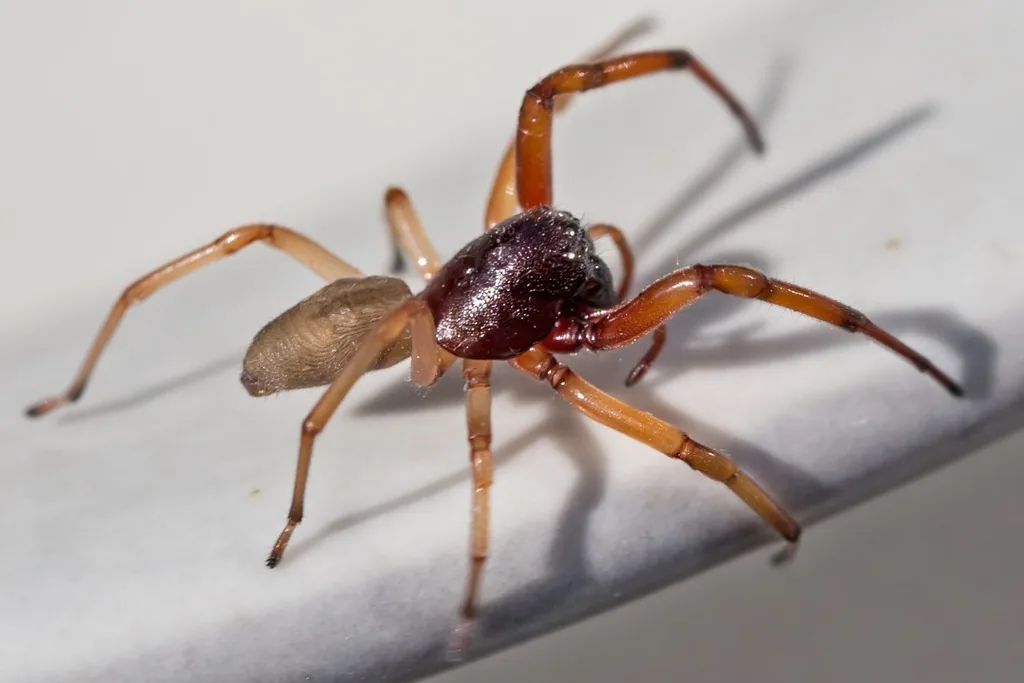
- The front body section and jaws are thick, hard and reddish brown with tiny pits; the abdomen is pale yellow to light gray with a slightly darker stripe.[1]
- The front pair of legs is darker and thicker, and each pair behind it is lighter and thinner.[1]
- Scientific name: long known as Trachelas tranquillus; a 2026 revision moved the American species out of Trachelas into the new genus Neochelas, so newer sources may call it Neochelas tranquillus.[6]
Look-alikes
| Look-alike | How to tell them apart |
|---|---|
| Yellow sac spider | Penn State describes the broad-faced sac spider by its thick, hard, reddish-brown front body and jaws and its darker, thicker front legs; it is the one with the shiny dark 'face'.[1] |
Where it lives
It ranges from New England and nearby Canada south to Georgia and Alabama and west to Kansas and Minnesota.[1]
Biology and life cycle
Outdoors it walks on foliage and hides by day in silken retreats under leaf litter, stones and boards and under windowsills and siding.[1]
It favors warm, dry spots; males mature and mate in midsummer, and in September or October each female lays a pure white sac of thirty to fifty eggs, often under loose bark.[1]
It has a reported habit of scavenging dead spiders and insects, which is unusual for a spider.[1]
Damage and signs
- It causes no damage to homes. Most indoor sightings come as temperatures fall in autumn, and it does not, as a rule, set up reproducing colonies indoors.[1]
Health risk
Penn State says the bite typically causes a painful red area like a bee or wasp sting. In a Connecticut case reported in 2014, a woman felt a painful wasp-like sting; the red spot was gone the next day with no tissue damage, and the authors called it only the second confirmed bite by this species. In a 2018 Philadelphia case, a toddler developed two firm pink plaques that were treated for inflammation and a suspected bacterial infection and cleared promptly. Penn State also mentions records of severe secondary infection after bites. Anyone who has trouble breathing or swelling of the face or mouth after a bite needs emergency help.[1][4][5][7]
Control
Keep them out
Seal cracks in the foundation and gaps around windows and doors, and check that window and door screens seal well to keep out spiders and the insects they eat.[2]
Sanitation
Keep clutter off the floor indoors and around the foundation outside, and in storage areas keep boxes off the floor and away from walls; taping boxes shut keeps spiders from moving in.[2]
Traps and physical control
Vacuum spiders and webs, especially in corners, storage areas and basements, or capture a spider in a jar and release it outside.[2]
Pesticides
Pesticides are not generally needed. Products labeled for spiders include pyrethrins and pyrethroids, but UC IPM notes that spraying works only when you hit the spider and is temporary unless you also cut clutter and hiding places.[2]
Common questions
- What is the spider with a shiny reddish-brown front wandering my house in fall?
- It may be a broad-faced sac spider; mature females often wander indoors in autumn.[1]
- Is the broad-faced sac spider dangerous?
- Its bite can hurt like a bee or wasp sting. Published cases describe a red spot that faded by the next day and, in a toddler, plaques treated for a suspected skin infection that cleared promptly.[1][4][5]
- What should I do after a spider bite?
- MedlinePlus advises washing the site with soap and water, then applying ice wrapped in a washcloth for 10 minutes on and 10 minutes off, and watching over the next several days for signs of infection such as increasing redness, swelling or pain. Call 911 for trouble breathing or swelling of the face or mouth.[7]
- Why do some sources call it Neochelas?
- A 2026 revision concluded that Trachelas does not occur in the Americas and moved the American species into the new genus Neochelas.[6]
Sources
- Penn State Extension, “Broad-Faced Sac Spider.” extension.psu.edu/broad-faced-sac-spider (accessed 2026-11-12)
- University of California Statewide IPM Program, “Spiders (Pest Notes, Home and Landscape).” ipm.ucanr.edu/home-and-landscape/spiders/ (accessed 2026-11-12)
- iNaturalist, “Trachelas tranquillus taxon page (order and family).” www.inaturalist.org/taxa/153871 (accessed 2026-11-12)
- Journal of Medical Entomology, via PubMed, “Envenomation by Trachelas tranquillus (Araneae: Corrinidae) in Connecticut (Vossbrinck and Krinsky 2014).” pubmed.ncbi.nlm.nih.gov/25276940/ (accessed 2026-11-12). Cited from the PubMed abstract.
- Pediatric Dermatology, via PubMed, “Trachelas tranquillus envenomation with presumed bacterial superinfection in a child (Smith et al. 2018).” pubmed.ncbi.nlm.nih.gov/30230593/ (accessed 2026-11-12). Cited from the PubMed abstract.
- Zootaxa, via PubMed, “On the American spider species formerly placed in Trachelas, with the proposal of the new genus Neochelas (Pett et al. 2026).” pubmed.ncbi.nlm.nih.gov/42408504/ (accessed 2026-11-12). Cited from the PubMed abstract.
- MedlinePlus, U.S. National Library of Medicine, “Insect bites and stings (Medical Encyclopedia 000033).” medlineplus.gov/ency/article/000033.htm (accessed 2026-11-12)