On this page
How to identify it
- Cotesia congregata, the hornworm parasitoid, is a black wasp up to about 1/8 inch long with slender antennae about as long as its body. NC State notes a dark spot on otherwise clear or smoky wings; Galveston County Master Gardeners describe yellowish legs and clear wings.[3][4]
- Braconids in general are usually dark, with four clear wings, and rarely more than 1/2 inch long. Females lay eggs through a tube called the ovipositor.[4]
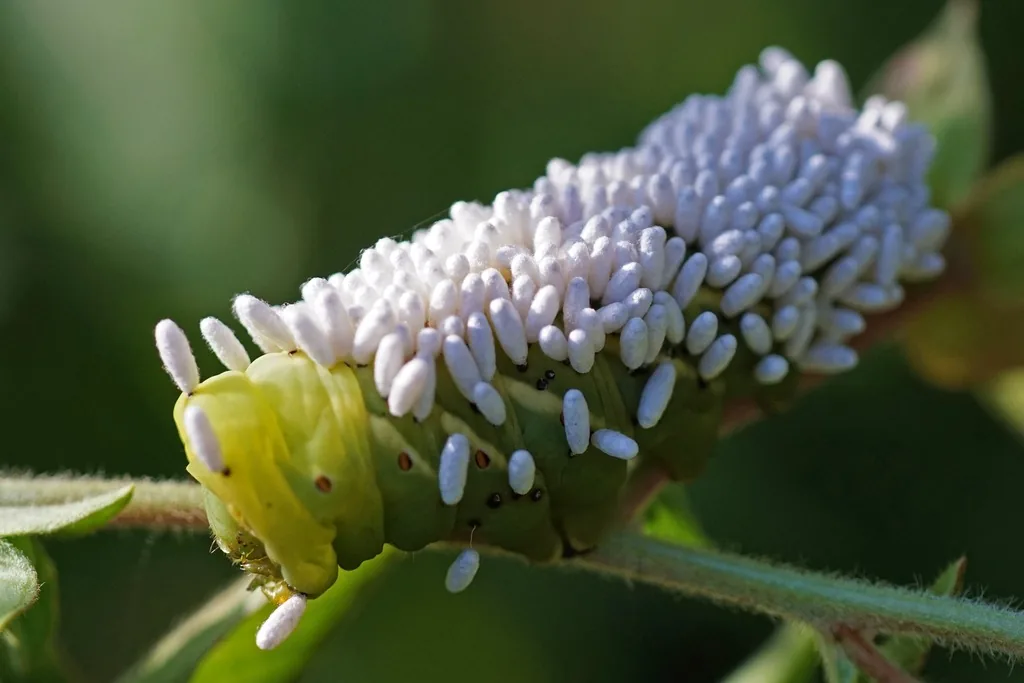
- Cocoons are small silken cases, white to golden or yellowish, attached to the host caterpillar or nearby leaves; the alfalfa caterpillar Cotesia's cocoon is about 1/6 inch long.[1][3][2]
- On a tomato hornworm the cocoons stick out of the body like grains of white rice.[1]
- One hornworm can carry a lot of them: Galveston County Master Gardeners counted 154 Cotesia cocoons on a single tobacco hornworm.[4]
Where it lives
More than 1,000 braconid species occur in the United States, and over 15,000 have been described. Their hosts include beetle, caterpillar, fly and sawfly larvae, and the family also attacks aphids, squash bugs and stink bugs.[2][4]
Biology and life cycle
A female Cotesia congregata finds hornworms partly by the smell of caterpillar-damaged plants. She injects a few to more than 300 eggs into the caterpillar's blood, along with venom and virus particles that keep its immune system from attacking the eggs.[3]
The wasp larvae feed inside the living host, then chew out and spin cocoons on its skin; the hornworm dies after the wasps emerge.[1][3][4]
For C. congregata, egg to larvae chewing out of the caterpillar usually takes about 2 weeks (5 to 16 days), and adults leave the cocoons 3 to 8 days later; Galveston County Master Gardeners saw adults appear four days after the larvae emerged. The alfalfa caterpillar Cotesia also takes about two weeks from egg to adult in summer.[3][4][2]
Adults feed on honeydew and nectar. The alfalfa caterpillar Cotesia lives 2 to 3 weeks, and C. congregata can be found sipping nectar on flowers.[2][3]
Late in the season, C. congregata larvae spin cocoons and stay inside them through winter, pupating the next spring. These cocoons sometimes fall off the caterpillar, and the larvae survive on the soil surface.[3]
Different braconids attack their hosts as eggs, larvae, pupae or adults, from inside or outside the body, and each species tends to specialize on particular hosts.[4]
Damage and signs
Health risk
Sources differ a little on stings. NC State calls Cotesia congregata harmless to humans, and Galveston County Master Gardeners say these tiny hornworm wasps do not sting. They add that braconid females in general can sting with the ovipositor but rarely do unless trapped or mishandled.[3][4]
Control
Prevention
If a hornworm carries white cocoons, leave it in the garden so the adult wasps can emerge and parasitize more hornworms. NC State notes gardeners sometimes mistake the cocoons for eggs the hornworm laid and destroy them.[1][3]
Biological control
Avoid broad-spectrum, persistent insecticides. UC IPM points to Bacillus thuringiensis for caterpillars because it doesn't poison natural enemies, and Minnesota Extension notes that pyrethroids and other broad-spectrum products can kill beneficial insects.[2][1]
Flowering plants supply nectar that nourishes adult parasitic wasps.[2][3]
Common questions
- What are the white things sticking out of my hornworm?
- They're cocoons of a braconid wasp. Its larvae fed inside the hornworm, which will die when the adult wasps emerge.[1]
- Will these wasps sting me?
- Very unlikely. NC State calls the hornworm wasp harmless to humans, and Galveston County Master Gardeners say braconids generally sting only when trapped or mishandled.[3][4]
Sources
- University of Minnesota Extension, “Tomato hornworms.” extension.umn.edu/yard-and-garden-insects/tomato-hornworms (accessed 2026-11-12)
- University of California Statewide IPM Program, “Alfalfa Caterpillar Cotesia Parasitoid (Natural Enemies Gallery).” ipm.ucanr.edu/natural-enemies/alfalfa-caterpillar-cotesia-parasitoid/ (accessed 2026-11-12)
- NC State Extension, “Cotesia Congregata, Parasitoid (PDIC Factsheet).” content.ces.ncsu.edu/cotesia-congregata-parasitoid (accessed 2026-11-12)
- Galveston County Master Gardeners, Texas A&M AgriLife Extension, “Braconid Wasp on Hornworms.” txmg.org/galveston/beneficials-in-the-garden-and-landscape/braconid-wasp-on-hornworms/ (accessed 2026-11-12)
- iNaturalist, “Cotesia congregata taxon page (order and family).” www.inaturalist.org/taxa/1449989 (accessed 2026-11-12)