On this page
How to identify it
- Mature caterpillars are green speckled with black and yellow, with a dark line down the back and two yellow lines along the upper sides. Like other skipper caterpillars, they have a distinct neck and a relatively large head.[1]
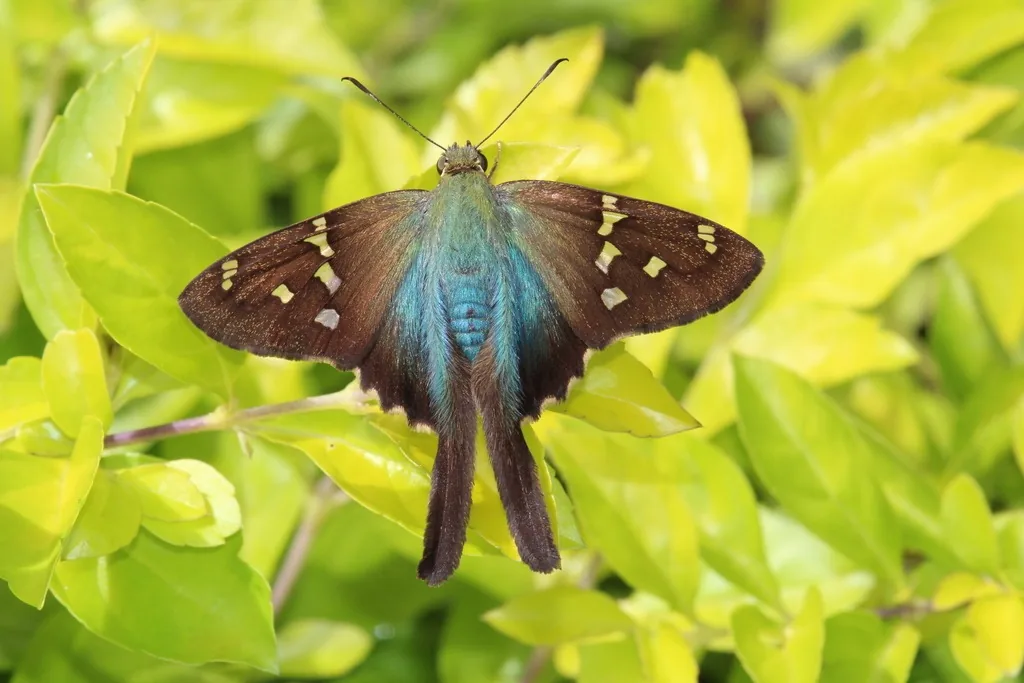
- The adult has long tails on the hind wings. The upper side is dark blackish brown, and the body and wing bases are iridescent blue-green. Wingspan is 1 3/4 to 2 5/16 inches (4.5 to 6 cm). UF/IFAS gives a wingspan of about 50 mm (2 in), with wings chocolate brown above and pale brown below, five to seven square or rectangular spots on the forewings, and green iridescent scales on the wings and body.[2][8]
- Skippers fly with a skipping motion, and their antennae are set farther apart than a butterfly's and hooked back at the tips.[1]
- UF/IFAS describes young caterpillars as yellowish with a brownish-black head and neck shield. From the second stage the back is sprinkled with small black spots, and from the third the yellow side lines become distinct. Older caterpillars also have orange spots on the head near the jaws, and the body tapers sharply at both ends.[8]
- Eggs are slightly flattened spheres about 1 mm (1/32 in) across, white at first and soon yellow. The pupa, formed inside the leaf shelter, is about 20 mm (3/4 in) long, yellow to brown and covered with bluish-white fuzz.[8]
Where it lives
It ranges from Argentina north through Central America, the West Indies and Mexico to peninsular Florida and south Texas, and strays north, sometimes breeding, as far as Connecticut, southern Illinois, eastern Kansas, southern Arizona and southern California. GBIF has about 21,000 U.S. records since 1990, most from Florida, then Texas, South Carolina, Georgia, Alabama, Louisiana and North Carolina, with about 1,600 from Mexico and 1,300 from Costa Rica. UF/IFAS says it is found throughout Florida and along the coast from South Carolina to eastern Texas and spreads into most southeastern states each year, but it can't tolerate prolonged freezing and persists in the U.S. only in the southern coastal plain, perhaps only in southern Florida.[2][3][4][8]
Biology and life cycle
Females lay eggs on the undersides of leaves. NC State says about 80 eggs are laid singly or in small groups; BAMONA says in clusters of up to 20.[1][2]
Eggs hatch three or four days later. The caterpillars mature in about two weeks and pupate inside the leaf roll, and new adults emerge one to three weeks later.[1]
There are two to three broods through the year in south Florida and south Texas.[2]
Caterpillars feed on vine legumes, including beans, hog peanut, beggar's ticks, blue peas and wisteria. Adults drink nectar from bougainvillea, lantana, shepherd's needle and other flowers, roost upside down under leaves, and males perch 3 to 6 feet up in sunny openings to wait for females. UF/IFAS lists cowpea, lima bean, pea, snap bean and soybean, plus wisteria, tick trefoils, butterfly pea and hog peanut, and says the caterpillars eat only legume leaves.[2][8]
UF/IFAS counts five larval stages taking 15 to 20 days and a pupal stage of seven to 20 days; the whole cycle can take about 30 days. It breeds year-round in southern Florida but is uncommon in northern Florida until June and abundant only late in the season, usually September to October.[8]
Large numbers of adults migrate south through Florida in autumn, with a less obvious northward migration in spring and summer.[8]
A young caterpillar cuts a small triangular flap at the leaf edge, folds it over and lines it with silk. By the third or fourth stage it folds over a larger section of leaf or webs two leaves together. It leaves the shelter to feed, at night.[8]
Damage and signs
- Look for ragged leaves and leaves rolled up into shelters. NC State calls it a very minor pest of beans in North Carolina but a real nuisance farther south, and BAMONA notes it is sometimes a pest of snap beans.[1][2]
- In Brazil it is an important pest of several legume crops.[5]
- Each caterpillar eats about 190 sq cm (29.5 sq in) of foliage. Beans tolerate up to about 30 percent leaf loss without yield loss, so UF/IFAS estimates about four caterpillars must finish developing on a typical bean plant to do damage; since about half die at each stage, that takes about 140 eggs or 70 first-stage caterpillars per plant.[8]
Health risk
It feeds on plants, and no cited source describes any risk to people or pets.[1][2]
Control
Traps and physical control
Check plants by eye: the caterpillars hide in leaf folds and are hard to dislodge, but the shelter-building damage is easy to spot.[8]
Biological control
Natural enemies do much of the work: Trichogramma wasps parasitize the eggs, tachinid flies and a tiny wasp parasitize the caterpillars, paper wasps and predatory stink bugs eat them, and a nuclear polyhedrosis virus kills them. In Florida, UF/IFAS reports a tachinid fly reared from the caterpillars, Polistes wasps and stink bugs as predators, and a virus that killed up to 40 to 50 percent of caterpillars late in the season when they were numerous.[1][8]
In Brazilian snap beans, 44.9 percent of collected eggs were parasitized by the egg wasp Trichogramma bruni, and a new baculovirus has been isolated from its caterpillars.[6][5]
Pesticides
If treatment is needed, a pesticide labeled for vegetable pests should give more than adequate control. UF/IFAS says most foliar insecticides are very effective but should be needed only on late-season beans, and that Bacillus thuringiensis is not currently recommended.[1][8]
Where the sources disagree
Egg laying: NC State says a female lays about 80 eggs, singly or in small groups, while BAMONA says eggs are laid in clusters of up to 20.[1][2]
How much of a pest it is: NC State calls it a very minor pest of beans in North Carolina but a real nuisance farther south, BAMONA says it is sometimes a pest of snap beans, and Brazilian researchers describe it as an important pest of several legume crops there.[1][2][5]
Egg clusters: UF/IFAS says eggs are laid singly or in small clusters of two to six, smaller than BAMONA's clusters of up to 20.[8][2]
Caterpillar color: NC State describes mature caterpillars as green speckled with black and yellow; UF/IFAS describes a yellowish body sprinkled with black spots, lighter below.[1][8]
Development: NC State says caterpillars mature in about two weeks; UF/IFAS gives 15 to 20 days.[1][8]
Common questions
- What's rolling up my bean leaves?
- Often bean leafroller caterpillars, which roll leaves into shelters and feed inside them.[1]
- Do I need to spray?
- Usually not in the North Carolina area, where it is a very minor pest and many natural enemies attack it. If damage gets heavy, a pesticide labeled for vegetables will control it.[1]
- How many caterpillars does it take to hurt my beans?
- More than you might think. UF/IFAS says beans tolerate about 30 percent leaf loss without yield loss, which takes about four caterpillars completing development on a typical plant.[8]
Sources
- NC State Extension, “Bean Leafroller.” content.ces.ncsu.edu/bean-leafroller (accessed 2026-11-13)
- Butterflies and Moths of North America (BAMONA), “Long-tailed Skipper, Urbanus proteus (species page).” www.butterfliesandmoths.org/species/Urbanus-proteus (accessed 2026-11-13)
- Global Biodiversity Information Facility (GBIF), “Urbanus proteus: U.S. occurrence records since 1990 by state (GBIF occurrence search).” api.gbif.org/v1/occurrence/search?taxonKey=1944314&country=US&hasGeospatialIssue=false&occurrenceStatus=PRESENT&year=1990%2C2026&facet=stateProvince&facetLimit=400&limit=0 (accessed 2026-11-13). Exact count at access: 20,997 U.S. records since 1990 (Florida 6,003; Texas 4,488; South Carolina 2,612; Georgia 2,484; Alabama 1,469; Louisiana 1,228; North Carolina 1,006).
- Global Biodiversity Information Facility (GBIF), “Urbanus proteus: occurrence records since 1990 by country (GBIF occurrence search).” api.gbif.org/v1/occurrence/search?taxonKey=1944314&hasGeospatialIssue=false&occurrenceStatus=PRESENT&year=1990%2C2026&facet=country&limit=0 (accessed 2026-11-13). Exact counts at access: 25,741 records since 1990; United States 20,997, Mexico 1,589, Costa Rica 1,326, Brazil 349, Colombia 253.
- Virus Research, via PubMed, “The complete genome sequence of the first hesperiid-infecting alphabaculovirus isolated from the leguminous pest Urbanus proteus (Santos et al. 2018).” pubmed.ncbi.nlm.nih.gov/29571652/ (accessed 2026-11-13)
- Neotropical Entomology, via PubMed, “First report of parasitism of Trichogramma bruni in eggs of Urbanus proteus in snap beans (Pratissoli et al. 2007).” pubmed.ncbi.nlm.nih.gov/17710338/ (accessed 2026-11-13)
- Global Biodiversity Information Facility (GBIF), “Urbanus proteus (Linnaeus, 1758) (GBIF Backbone Taxonomy).” api.gbif.org/v1/species/1944314 (accessed 2026-11-13)
- University of Florida IFAS Extension, EDIS (Featured Creatures), “Bean Leafroller, Urbanus proteus (Linnaeus), EENY-001/IN127 (Featured Creatures).” ask.ifas.ufl.edu/publication/IN127 (accessed 2026-11-14)