On this page
How to identify it
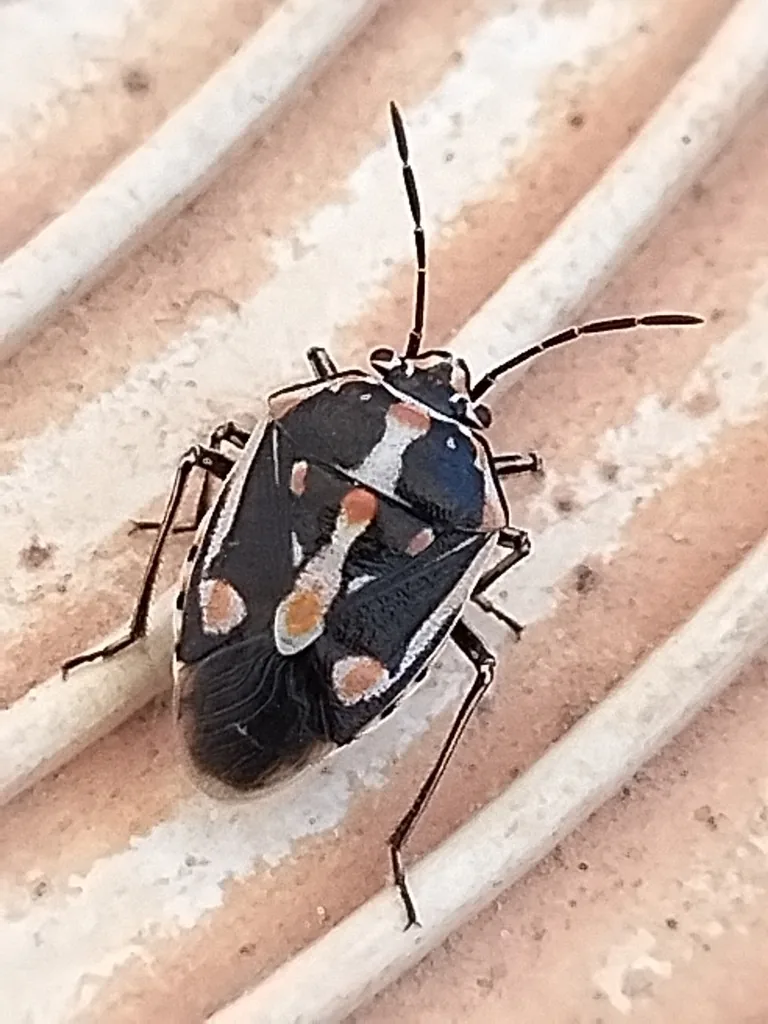
- Adults are black with orange and white markings, shield shaped and about 1/4 inch (5 to 7 mm) long; females are larger than males.[1]
- Eggs are barrel shaped, white turning orange or red before hatching, and laid singly or in small clusters of about six, mostly in the soil under host plants but also on leaves and on row covers or mesh screens.[1]
- Nymphs pass through five stages. Newly molted nymphs are orange-red, then the head, thorax and legs darken to black; older nymphs show dark wing pads and white spots on the abdomen.[1]
Look-alikes
| Look-alike | How to tell them apart |
|---|---|
| Harlequin bug | The harlequin bug looks similar, but the Bagrada bug is only one-third to one-fifth its size.[1] |
| Lady beetles | Bright nymphs can be mistaken for lady beetles but lack their shiny hard wing covers.[1] |
Where it lives
Native to Africa and Asia; see where the sources disagree on exactly where. In the U.S. it was first found in Los Angeles County in 2008, spread through much of California and is now in Arizona, New Mexico, Nevada, Utah and Texas.[1][3][2]
Biology and life cycle
A female can lay up to 150 eggs in two to three weeks, and eggs can hatch in four days.[1]
Southern California has multiple generations a year, peaking in late summer and fall, and all life stages can be on plants at once. Adults tend to fly above 85°F and hide in leaf litter or topsoil during cool periods and winter.[1]
Mustard-family plants are its main hosts and it needs them to reproduce well: wild mustards, shepherd's purse, London rocket, cole crops, radish and arugula, and ornamentals such as sweet alyssum, stock, candytuft, nasturtium and wallflower.[1]
When crucifers run short it can feed on other plants, damaging fruit of bell pepper, melon, tomato and others, and it forms large clusters on many plants in late summer.[1]
Damage and signs
Health risk
UC IPM and Arizona Extension describe a plant pest and don't mention any risk to people or pets. A 2018 report from Chile, where the bugs invaded homes, described the first known accidental bite of a person by this species and mentioned alleged cases of work-related allergy.[1][3][4]
Control
Prevention
Inspect new plants and containers right after watering, when hiding bugs are flushed out.[1]
Keep them out
Cover plants with fine mesh or row cover raised off the leaves, edges buried, before the bugs arrive.[1]
Sanitation
Remove mustard-family weeds and crop residue; where bugs are dense, replace sweet alyssum with non-mustard plants.[1]
Traps and physical control
Shake plants over a sheet and collect or vacuum the bugs; hand-picking works only when numbers are low.[1]
Pyramid traps baited with crushed sweet alyssum in a polypropylene bag can catch the bugs when numbers are high; lures made for other stink bugs don't attract Bagrada bugs.[1]
Biological control
Spiders and other general predators may eat it, but eggs laid in soil escape most egg parasitoids; see where the sources disagree on whether any natural enemy is effective in the U.S.[1][2]
Pesticides
UC IPM says there is little information on home-garden insecticides for it; stink bugs are hard to control with sprays, adults fly off and return, and covers or removing host plants usually work better. Research on organic cole crops suggests pyrethrum may suppress adults and azadirachtin or insecticidal soap may reduce nymphs.[1]
More from Arizona Extension
Arizona Extension says it was first found in California in June 2008 and identified in Yuma, Arizona, in September 2009, and has since been confirmed in La Paz, Maricopa, Pima and Pinal counties. It is in the same family as the harlequin bug but smaller and patterned differently.[3]
Where the sources disagree
Native range: UC IPM says it is native to Africa and has spread to India, Pakistan, parts of Southeast Asia and Italy; Arizona Extension lists Africa, India and Pakistan among its native areas; the 2016 review says eastern and southern Africa and Asia.[1][3][2]
Natural enemies: UC IPM and the 2016 review say the U.S. has no effective natural enemies of it. A 2023 study in north-central California found the wasp Gryon aetherium, which can search the soil, parasitizing about 8% to 9% of eggs collected, ranging from about 1% to 45% by site and year.[1][2][5]
Sprays: the 2016 review says commercial management has relied on repeated insecticide applications, with several pyrethroids and neonicotinoids the most effective. UC IPM says there is little information for home gardens, that stink bugs are hard to control with sprays, and that home growers will likely do better with covers or by removing host plants.[2][1]
Common questions
- What are the starburst marks on my kale leaves?
- Light-green starburst lesions are an early sign of Bagrada bug feeding.[1]
- Will row covers stop Bagrada bugs?
- Yes, if the mesh is fine, raised off the plants and buried at the edges before bugs arrive.[1]
- When should I look for Bagrada bugs?
- During the warm part of the day, when they are most active; on cool or cloudy days they hide under leaves, at stem bases and in soil cracks. UC IPM suggests checking more often once temperatures pass 75°F.[1]
Sources
- University of California Statewide IPM Program, “Pest Notes: Bagrada Bug (Publication 74166).” ipm.ucanr.edu/PMG/PESTNOTES/pn74166.html (accessed 2026-11-13)
- Annu Rev Entomol 2016;61:453-473, via PubMed, “Biology, Ecology, and Management of an Invasive Stink Bug, Bagrada hilaris, in North America (2016).” pubmed.ncbi.nlm.nih.gov/26735645/ (accessed 2026-11-13)
- University of Arizona Cooperative Extension, “Bagrada Bug: A Pest for Arizona Gardeners.” extension.arizona.edu/publication/bagrada-bug-pest-arizona-gardeners (accessed 2026-11-13)
- J Med Entomol 2018;55(5):1365-1368, via PubMed, “From Agricultural to Household Pest: The Case of the Painted Bug Bagrada hilaris (Burmeister) (Heteroptera: Pentatomidae) in Chile (2018).” pubmed.ncbi.nlm.nih.gov/29931070/ (accessed 2026-11-13)
- J Econ Entomol 2023;116(5):1559-1566, via PubMed, “Parasitism by Gryon aetherium (Hymenoptera: Scelionidae) on Bagrada hilaris (Hemiptera: Pentatomidae) eggs in northcentral California (2023).” pubmed.ncbi.nlm.nih.gov/37651730/ (accessed 2026-11-13)
- Global Biodiversity Information Facility (GBIF), “Bagrada hilaris (Burmeister, 1835) (GBIF Backbone Taxonomy).” api.gbif.org/v1/species/4485918 (accessed 2026-11-13)
- iNaturalist, “Bagrada hilaris taxon page (order and family).” www.inaturalist.org/taxa/152131 (accessed 2026-10-06)