On this page
How to identify it
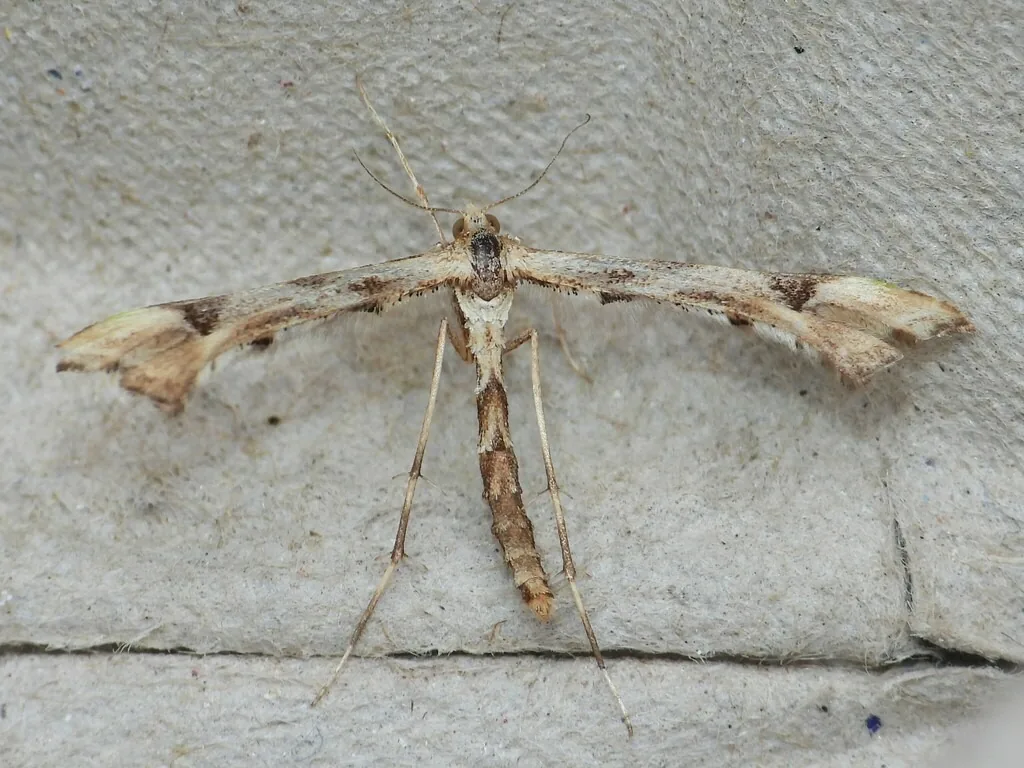
- Adults are buff to brownish buff with a wingspan of 0.75 to 1.25 inches; the wings are split into lobes, and the hind wings are fringed.[1]
- Young larvae are pale yellow; grown larvae are off-white turning yellowish to pink, about 5/8 inch long.[3][2][1]
- Eggs are tiny and shiny, light greenish yellow turning orange-yellow, usually laid singly under leaves and sometimes on the bud stalk.[1][2]
Look-alikes
| Look-alike | How to tell them apart |
|---|---|
| Calendula plume moth | A related plume moth that lives alongside it in California. The two use the same sex pheromone and keep apart by mating at different times, so pheromone-trap catches may include both.[5] |
Where it lives
It's mainly a problem where artichokes are perennial, chiefly California's central coast; in southern California artichokes are usually grown as annuals. The PNW handbook also covers it in the Pacific Northwest, and in a restored-prairie study it mined the growing tips of wild tall thistle, cutting the plants' seed production.[2][1][4]
Biology and life cycle
Females lay about 245 eggs on average. Young larvae feed outside the leaf, then tunnel into the leaf stalk after their first molt; larvae that hatch near the buds mine the outer bracts and work toward the center of the bud with each molt.[2][3][1]
Mature larvae drop to the ground and pupate in plant debris, often in folds of dried leaves; there are three to four overlapping generations a year.[1]
On the mild central coast the last larval stage keeps developing at temperatures as low as 35 F, so the moth breeds year-round.[2]
Damage and signs
Health risk
It feeds on artichokes and thistles; neither UC IPM nor the PNW handbook mentions any risk to people.[1][2]
Control
Sanitation
Cutting plants back, shredding the tops and working them into the soil can cut infestations by about 95%, though moths fly in from other plantings. The PNW handbook says to cut at ground level; UC IPM's farm guidelines say 2 or 3 inches below soil level. UC IPM's home-garden advice is to cut all plants to ground level once a year for two to three months, bury the cuttings under at least 6 inches of soil, and remove nearby thistles.[1][2][3]
At harvest, pick and dispose of infested buds whatever their stage.[1]
Biological control
Sources differ on nematodes. UC IPM's farm guidelines and the PNW handbook say soaking replant stumps in Steinernema carpocapsae can, if done correctly, cut infestations below 1%; UC IPM's home-garden page calls nematodes possibly helpful but not reliable.[2][1][3]
Parasitic wasps attack the larvae but seldom control it, because the larvae spend most of their time inside the plant.[2][1]
Pesticides
Home-use options in the PNW handbook include neem (azadirachtin), pyrethrins and esfenvalerate. Timing matters most: aim at the first-stage larvae before they bore in. Follow the product label.[1]
Monitoring
Pheromone traps show when moths are flying; UC IPM and the PNW handbook say seven or more moths a week may signal a coming problem.[2][1]
Eggs are hard to spot. Check leaves weekly in spring, summer and fall, and check shoots for larvae.[2][1]
Common questions
Sources
- Pacific Northwest Pest Management Handbooks (OSU, WSU, University of Idaho), “Artichoke (globe artichoke): Artichoke plume moth (Insect Management Handbook).” pnwhandbooks.org/insect/vegetable/vegetable-pests/hosts-pests/artichoke-globe-artichoke-artichoke-plume-moth (accessed 2026-11-13)
- University of California Statewide IPM Program, “Artichoke Plume Moth (UC IPM Pest Management Guidelines: Artichoke).” ipm.ucanr.edu/agriculture/artichoke/artichoke-plume-moth/ (accessed 2026-11-13)
- UC Statewide IPM Program (UC IPM), “Artichoke Plume Moth (Home and Landscape).” ipm.ucanr.edu/home-and-landscape/artichoke-plume-moth/ (accessed 2026-11-13)
- American Journal of Botany, 2014 (via PubMed), “Effects of apical meristem mining on plant fitness, architecture, and flowering phenology in Cirsium altissimum (Asteraceae) (abstract).” pubmed.ncbi.nlm.nih.gov/25480705/ (accessed 2026-11-13)
- Journal of Chemical Ecology, 1987 (via PubMed), “Identification of sex pheromone of calendula plume moth Platyptilia williamsii (abstract).” pubmed.ncbi.nlm.nih.gov/24302055/ (accessed 2026-11-13)
- Global Biodiversity Information Facility (GBIF), “Platyptilia carduidactylus (Riley, 1869) (GBIF Backbone Taxonomy).” api.gbif.org/v1/species/1859161 (accessed 2026-11-13)