On this page
How to identify it
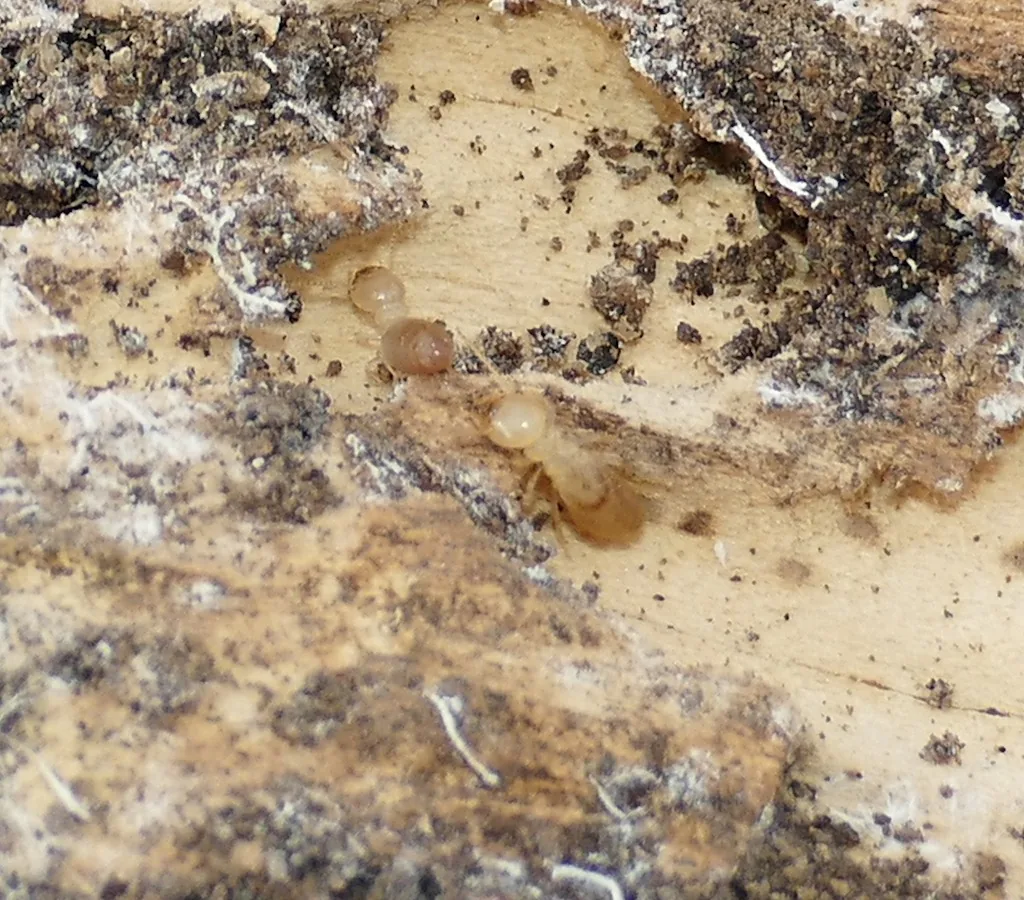
- Soldiers have dull brownish heads with slightly curved sides, and the outer edge of the left jaw is less curved than in the western subterranean termite, whose soldiers have pale, yellowish heads with parallel sides and S-shaped jaws. The jaws are thick and slightly shorter than the width of the head, which separates it from the desert subterranean termite.[3][1]
- Swarmers are dark brown to black and a little over 1/4 inch long with almost colorless wings; desert subterranean termite swarmers are much lighter, tan insects. Unusually for a subterranean termite, flights happen in daylight on sunny days rather than at night.[1]
- Its mud shelter tubes are flatter, less solidly built and a dirty dark brown, unlike the small, strong, nearly airtight, light-colored round tubes of the desert subterranean termite.[1]
- Reticulitermes identification in the West is unsettled: genetic studies show the western subterranean termite is a complex of two or more species, a new species (R. rusti) was described from southern California in 2025, Arizona samples fall into several clades, and confirming a species may take DNA sequencing.[2][3]
Look-alikes
| Look-alike | How to tell them apart |
|---|---|
| Western subterranean termite (Reticulitermes hesperus) | The other described western Reticulitermes; its soldiers have pale yellowish, long, narrow heads with parallel sides rather than the dark, broad head of R. tibialis.[1][3] |
| Desert subterranean termite (Heterotermes aureus) | The dominant and most destructive termite of the hot Sonoran desert below 4,000 feet, with tan swarmers and small, strong, light-colored round mud tubes; R. tibialis is much less common there.[1] |
| Eastern subterranean termite and other Reticulitermes | The genus page for the eastern species; R. tibialis is the arid-land representative of the same genus, reaching east to Indiana.[1] |
Where it lives
Semi-arid prairies, steppes and deserts of the Great Basin and Rocky Mountain states, east as far as Indiana and west into central, southern and Baja California. In Arizona it is the most widely distributed subterranean termite, recorded from Yuma to Bullhead City and north to Page, and the most common termite pest in the Flagstaff area. In Colorado it occurs below about 7500 ft, and Wisconsin colonies in the southern half of the state mark the northern edge of its range.[1][5][7]
Biology and life cycle
The species has two flight seasons, one in winter and one in the summer rains, and which one a site sees depends on elevation: above 4,000 feet colonies swarm in summer, usually June and July, while in the hotter, more arid areas below 4,000 feet a small number of flights occur from January to March. Swarms are noticed less often than those of other subterranean termites, partly because they fly by day.[1]
Like other subterranean termites it lives in the soil and reaches wood above ground by building shelter tubes over foundations, but it is much less persistent about tubing up to structures than other subterranean species, and it prefers higher humidity. Genetic work has found that Reticulitermes swarming in spring and in fall in the West are reproductively isolated species.[1][2]
In Colorado it is found through most of the state below about 7500 ft and is very common on the eastern plains, where it is easily found by turning over fallen logs or dried cattle manure.[5]
At the northern edge of its range, genetic surveys found it with the eastern subterranean termite in the southern half of Wisconsin.[7]
Fun fact: termites cannot digest wood on their own. The gut of the arid-land subterranean termite holds at least 41 species of single-celled protists that help with the job.[8]
Damage and signs
- An economic pest across the western states. In its natural habitat it does a moderate amount of damage to plant roots and stems; around people it can do substantial damage to untreated posts, utility poles and wooden buildings, and its shelter tubes let it attack structural wood inside a house.[1]
- Two habits moderate the damage: it is less persistent than other subterranean termites in building tubes up to wood, and when it does enter a building it is more likely to attack moist, decaying wood than dry, sound lumber. The University of Arizona notes that Arizona termites generally take some time to become established, so prompt treatment after detection avoids serious structural damage.[1]
- Damage to Colorado structures has not been very common compared with wetter or warmer parts of the country. It has long been reported where water tables are high, such as Del Norte and Burlington, and much of it traces to extra moisture around buildings from poorly aimed landscape irrigation and downspouts draining next to the foundation.[5]
Health risk
A wood pest; the sources describe no effect on people beyond damage to buildings.[1]
Control
Prevention
Keep the soil next to the house dry: aim irrigation away from the foundation and carry downspout water away from foundation walls. Inspect once or twice a year, or have a professional inspect annually, for mud tubes, new holes in wood, recurring sawdust or pellets, shed wings near lights and swarmers. Before construction, remove stumps and large roots within 25 feet of the building and have concrete poured within 24 hours of the soil termiticide application.[5][1]
Pesticides
For subterranean termites the options are liquid termiticides, applied by rodding, trenching and sub-slab injection around the home, which have been the industry standard for decades, or a baiting program in which monitored stations hold a cellulose bait matrix the termites feed on and die.[1]
When to call a professional
If you find signs, request a professional inspection, checking references with neighbors, the Better Business Bureau or the state structural pest control board; the control method depends on which species is present and where it is in the structure. Because western Reticulitermes species are hard to tell apart, a laboratory may confirm the species by DNA sequencing.[1][3]
Where sources disagree
Moisture: the University of Arizona says this species prefers higher humidity and, in buildings, moist decaying wood, but a Purdue laboratory study of Indiana termites found no significant difference in how much R. tibialis fed across soil moisture levels.[1][6]
Pest status: in Arizona it is the most common termite pest around Flagstaff, while in Colorado, Extension says the eastern subterranean termite usually causes the structural damage.[1][5]
Common questions
- Termites swarmed out of my yard on a sunny afternoon in June in Flagstaff. Which kind?
- Daytime flights of dark swarmers with nearly clear wings in summer at elevations above 4,000 feet fit the arid-land subterranean termite, the most common termite pest around Flagstaff. Most other subterranean termites fly at night.[1]
- Is it as destructive as the desert subterranean termite?
- It is a significant structural pest, but it is less persistent at building tubes into houses and prefers moist, decaying wood over dry sound lumber; the University of Arizona rates the desert subterranean termite the most destructive termite in the state.[1]
- How do I know it is R. tibialis and not the western subterranean termite?
- Soldiers help in the field: R. tibialis has a dull brownish head with slightly curved sides, while R. hesperus has a pale yellowish head with parallel sides. Western Reticulitermes are a species complex, a new species was described from southern California in 2025, and researchers recommend DNA sequencing for a reliable identification.[3][1][2]
- Is this the termite damaging houses in Colorado?
- Usually not. Colorado State University Extension says the arid-land subterranean termite is the most widespread species in the state, but the eastern subterranean termite is usually the one responsible for damage to structures.[5]
Sources
- University of Arizona Cooperative Extension, “Arizona Termites of Economic Importance, az1369 (Baker and Marchosky, June 2005).” extension.arizona.edu/sites/extension.arizona.edu/files/pubs/az1369.pdf (accessed 2026-11-12)
- Journal of Economic Entomology (Entomological Society of America), “Tseng, Nelson, Hubble, Sutherland, Haverty and Lee (University of California Riverside, USDA Forest Service and UC IPM). Phylogenetic analyses of Reticulitermes (Blattodea: Rhinotermitidae) from California and other western states: multiple genes confirm undescribed species identified by cuticular hydrocarbons. Journal of Economic Entomology 116: 2048-2059 (2023), PMID 37797286.” pubmed.ncbi.nlm.nih.gov/37797286/ (accessed 2026-11-12)
- Annals of the Entomological Society of America, “Description of a new species of subterranean termite in the genus Reticulitermes (Blattodea: Heterotermitidae) from southern California. Annals of the Entomological Society of America 118 (2025), PMC12285582.” pmc.ncbi.nlm.nih.gov/articles/PMC12285582/ (accessed 2026-11-12)
- iNaturalist, “Reticulitermes tibialis taxon page (order and family).” www.inaturalist.org/taxa/296466 (accessed 2026-11-12)
- Colorado State University Extension, “Termites in Colorado (PlantTalk 1400-3).” planttalk.colostate.edu/topics/insects-diseases/1400-3-termites-colorado (accessed 2026-11-12)
- Journal of Economic Entomology (2005), via PubMed, “Effect of soil moisture on feeding and harborage of three Reticulitermes species from Indiana (R. flavipes, R. tibialis, R. virginicus).” pubmed.ncbi.nlm.nih.gov/16022324/ (accessed 2026-11-12). Cited from the PubMed abstract.
- Environmental Entomology (2015), via PubMed, “Genetic Analysis of Termite Colonies in Wisconsin.” pubmed.ncbi.nlm.nih.gov/26313996/ (accessed 2026-11-12). Cited from the PubMed abstract.
- Protist (2025), via PubMed, “Protist symbionts of the termite Reticulitermes tibialis.” pubmed.ncbi.nlm.nih.gov/39929034/ (accessed 2026-11-12). Cited from the PubMed abstract.